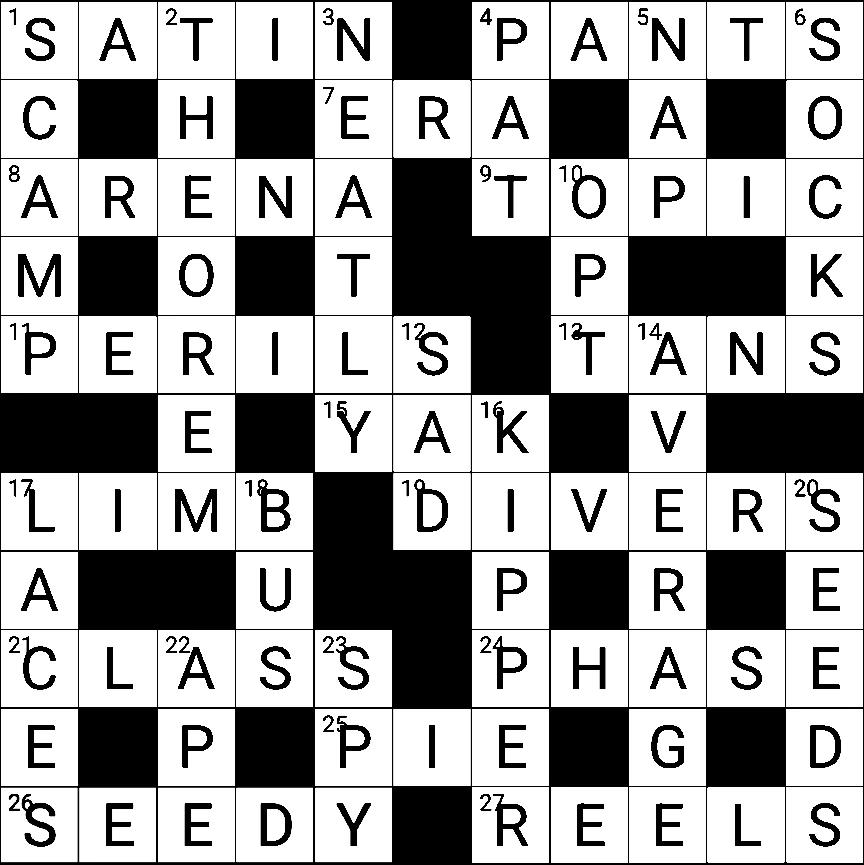
This week’s 11 x 11 crossword from the Guardian intended to teach cryptic crosswords, found here
This week’s puzzle sees the welcome return of Carpathian to the spot with her 19th Quick Cryptic puzzle. She was last seen on 8th November with puzzle #84. This puzzle has anagrams, hidden words and alternate letters with all the letters in the clues, plus dropped letters, which we’re seeing for the fourth time, last time with Dice in May, where the words and letters need to be found by the solvers. This crossword layout uses much shorter words, some overlapping completely, so there may be some clues that get filled in without solving, but work as a useful double check.
The whole point of these crosswords is support and encouragement of new solvers, so special rules for these crosswords apply – see here – those rules include not posting solving times.
This blog was developed in response to suggestions. We hide the answers and the wordplay descriptions (parsing) too. To find the solution click on “Answer” and to find how the word play works, click on “Parsing” which will reveal the hidden information. You can choose to reveal everything using the “Expand All” button. If you have partially revealed the page, refreshing it will clear that, and allow you to expand all. The definition is in bold and underlined, the indicator is in red.
For additional help click here
There is a summary of the tricks used in the first six months here and a Guardian Crossword blog called the ultimate beginner’s guide has tips which may be useful for some solvers.
For abbreviations and clue tips click here
Fifteen Squared uses several abbreviations and jargon tricks, there’s a full list here, of which I’ve used the following in this blog:
- underlining the definition in the clue – this is either at the beginning or end of the clue
- indicators are in red.
- CAPITALS to indicate which bits are part of the answer, e.g. haVE ALtered for the example.
- anagram – letters being used shown in brackets (SENATOR)* for the clue below to give TREASON.
- anagrind – anagram indicator – in the case below it is “arranged”
- soundalike – is indicated by “Wilde” – so in the example, Oscar “Wilde”, the playwright and author, is indicating the soundalike WILD.
- charades – the description below only gives the example of words being added together, but charades can be more complicated, adding abbreviations or single letters to another word. Examples previously used in this series are: Son ridicules loose overgarments (6) S (son) + MOCKS (ridicules), Get rid of dead pine (5) D(dead) + ITCH (pine) – D ITCH, and early on DR (doctor) + IVE (I have) to give DRIVE.
- reversals – the reversal element of a clue is indicated by < – so in the example clue below, VieTNAm <.
- CAD or clue as definition– where the whole clue gives the definition, sometimes called an &lit. These are rare.
- DBE or definition by example – e.g. where a dog might be clued as a setter – often using a question mark, maybe, possibly or e.g. to show that this is an example rather than a definition.
- surface – the meaning from reading the clue – so often cryptic clues use an English that could only be found in a cryptic crossword, but a smooth surface is a clue that has a meaning in English, which can be pointed or misleading.
TODAY’S TRICKS – from the crossword site – because the clues have moved on from the clue descriptions below, I am now adding more to the descriptions hidden above. Clues begin or end with a definition of the answer. The rest is one of these:
- Anagram Anagram of answer and hint that there’s an anagram
‘Senator arranged crime (7)’ gives TREASON - Hidden word(s) Answer hidden in clue’s words
‘Some haVE ALtered meat (4)’ gives VEAL - Dropped letter Remove a letter from another word
‘Time away from coach in wet weather (4)’ gives RAIN (wet weather)
from [t]RAIN (coach) – minus t (time away) - Alternate letters Choose every other letter for answer
‘Oddly EnViEd First Lady? (3)’ gives EVE
| ACROSS | Click on “Answer” to see the solutions | |
| 1 |
Material gratifying – that’s no good (5)
|
AnswerSATIN |
Parsingdrop a letter (that’s no good) – SATIN[g] (satisfying) without “g” (that’s no good). G for good comes from the quality of second-hand coins or books, |
||
| 4 |
Decorates without one item of underwear (5)
|
AnswerPANTS |
Parsingdrop a letter (without one) of PA[i]NTS (decorates) with the I dropped (without one). I is one in Roman numerals. |
||
| 7 |
Regularly retreat for period (3)
|
AnswerERA |
Parsingalternate letters (regularly) of rEtReAt. |
||
| 8 |
Prepare narrow section in field (5)
|
AnswerARENA |
Parsinghidden word(s) (in) in prepARE NArrow – with a cryptic definition. |
||
| 9 |
Subject of optic readjustment (5)
|
AnswerTOPIC |
Parsinganagram of (OPTIC)* with an anagrind of “readjustment”. |
||
| 11 |
Dangers of damaged pliers (6)
|
AnswerPERILS |
Parsinganagram of (PLIERS)* with an anagrind of “damaged”. |
||
| 13 |
Bronzes of army vehicles king disposed of (4)
|
AnswerTANS |
Parsingdrop a letter (king disposed of) from TAN[k]S (army vehicles) with the K removed (king disposed of). K for king comes from chess notation. |
||
| 15 |
Partly bury a kinky beast (3)
|
AnswerYAK |
Parsinghidden word(s) (partly) in burY A Kinky for this beast |
||
| 17 |
Mount skipping: cold leg? (4)
|
AnswerLIMB |
Parsingdrop a letter (skipping cold) from [c]LIMB (mount) without the C (skipping cold). C for cold comes from taps. |
||
| 19 |
Wanting energy, varied underwater explorers (6)
|
AnswerDIVERS |
Parsingdrop a letter (wanting energy) from DIVERS[e] (varied) with E removed (wanting energy). E for energy comes from physics. Think E = mc². |
||
| 21 |
Fastens missing page to form (5)
|
AnswerCLASS |
Parsingdrop a letter (missing page) from CLAS[p]S (fastens) with P removed (missing page). P for page comes from literature. |
||
| 24 |
Shape-changing spell (5)
|
AnswerPHASE |
Parsinganagram of (SHAPE)* with an anagrind of “changing” – think of time/spell for the definition being used here. |
||
| 25 |
Oddly missing spoiled dish (3)
|
AnswerPIE |
Parsingalternate letters (oddly missing) of sPoIlEd – the odd letters are missing here. |
||
| 26 |
Swift lacking power getting worn-out (5)
|
AnswerSEEDY |
Parsingdrop a letter (lacking power) from S[p]EEDY (swift) with the P removed (lacking power). P for power comes from science / physics. More about this meaning of worn out here |
||
| 27 |
Somewhere else holding dances (5)
|
AnswerREELS |
Parsinghidden word(s) (holding) in somewheRE ELse for these dances. |
||
|
DOWN
|
||
| 1 |
Prawns the writer chopped for rascal (5)
|
AnswerSCAMP |
Parsingdrop a letter (the writer chopped) from SCAMP[i] (prawns) with I removed (the writer, I, chopped). According to Wikipedia, scampi includes prawns. |
||
| 2 |
Hero met unusual proposition (7)
|
AnswerTHEOREM |
Parsinganagram of (HERO MET)* with an anagrind of “unusual”. |
||
| 3 |
Can eat lychee piece tidily (6)
|
AnswerNEATLY |
Parsinghidden word(s) (piece) in caN EAT LYchee. |
||
| 4 |
Stoke is strangely apt (3)
|
AnswerPAT |
Parsinganagram of (APT)* with an anagrind of “strangely” – and I suspect we have a typo here and the definition should be STROKE |
||
| 5 |
Encamps occasionally to sleep (3)
|
AnswerNAP |
Parsingalternate letters (occasionally) of eNcAmPs. |
||
| 6 |
Strikes and stuns leaving husband (5)
|
AnswerSOCKS |
Parsingdrop a letter (leaving husband) from S[h]OCKS (stuns) – if anyone wants to know why SOCKS means strikes there’s a blog discussing it here. |
||
| 10 |
Choose knitted top (3)
|
AnswerOPT |
Parsinganagram of (TOP)* with an anagrind of “knitted”. |
||
| 12 |
Low islands odd characters departed (3)
|
AnswerSAD |
Parsingalternate letters (odd characters departed) of iSlAnDs – the definition is referring to moods. |
||
| 14 |
Mean saver aged internally (7)
|
AnswerAVERAGE |
Parsinghidden word(s) (internally) of sAVER AGEd. And the mean is a measure of the average. |
||
| 16 |
Captain of boat dropping small fish (6)
|
AnswerKIPPER |
Parsingdrop a letter (dropping small) from [s]KIPPER (captain of boat) without the S (dropping small). S for small comes from clothing sizes. |
||
| 17 |
Fastens shaky scale (5)
|
AnswerLACES |
Parsinganagram of (SCALE)* with an anagrind of “shaky”. |
||
| 18 |
Club usually houses vehicle (3)
|
AnswerBUS |
Parsinghidden word(s) (houses) in cluB USually – usually pictured like this |
||
| 20 |
Horses taking time in pits (5)
|
AnswerSEEDS |
Parsingdrop a letter (taking time) from S[t]EEDS (horses) with T removed (taking time). T for time is also from science / physics. |
||
| 22 |
Copy magpies on and off (3)
|
AnswerAPE |
Parsingalternate letters (on and off) of mAgPiEs. |
||
| 23 |
Agent is in his pyjamas (3)
|
AnswerSPY |
Parsinghidden word(s) (in) in hiS PYjamas |
Well I’ve never heard that meaning of 26ac before – nice to learn something new. I thought the vocab needed for 1ac was a little obscure: my personal unenforceable rule is the first across clue in a puzzle should be nice and easy to welcome you in. But a fun puzzle overall – thanks to Carpathian.
I haven’t heard the definition of 26A before, but got it from the wordplay. This puzzle felt more doable than last weeks
Good Saturday morning fun. Some slightly obscure synonyms needed to be found perhaps if you were very new to crosswords. Thanks Shanne, and to Carpathian.
Enjoyed the dropped letter clues in particular. Very do-able. SATING isn’t a word that readily springs to mind – one to tuck up sleeve for future. 20D – I was trying to think of alternative words for the mine type of pit, as in coal. 6D SOCKS and 4A PANTS my favourites – bit of a theme…
@#1 Sumit – I get where you’re coming from.
Many thanks Shanne for the detailed blog and Carpathian for a perfectly pitched QC.
Shouldn’t 20d be “losing time”? I got in the end by trial and error.
9A doesn’t really work as the indicator is a noun immediately immediately following the anagram fodder – “X adjustment” does not mean “adjustment of X”.
Andrea @5 – if Carpathian wanted you to find the clue easy, yes, losing time would be the simpler way of cluing 20d, but taking time also says to take T away and it’s leading towards the more challenging cryptic clues.
Bagpuss @6 – cryptic crossword setters bend the language as far as they can. The clue doesn’t say X adjustment, it says X readjustment. I this case, I suspect Carpathian would argue that the clue really reads X re adjustment, so translates as X with an adjustment. Re- as a suffix often gets used to additionally change the meaning of clues.
@shanne, thanks.
Re: bagpuss, I didn’t notice that at the time, but I can see his point. To me your explanation was more cryptic than the clue itself 😀 😀
The dead tree version doesn’t have the clue for 23d.
I didn’t actually solve 4d as the crossers had given me all the letters. There is a correction to STROKE, but even so I think it’s a bit loose; stroke implies a continuous contact, whereas the solution is staccato!
@bagpuss “I’m taking my car to the garage for a steering adjustment” (or readjustment if the garage made it worse the first time!) – I think that’s fine, isn’t it?
8a: Would „section“ as the hidden word indicator not make (even more) sense?
Thanks Shanne for the truly helpful blog and Carpathian for the well-balanced QC!
Nice and quick. I thought all clues were straightforward and fair. I have no quibbles regarding stroke=pat or readjustment as the anagram indicator. I thought for awhile if arena is actually a field, thinking it is more of an enclosed area, but I guess if can be a field surrounded by seats. Thanks, Carpathian and Shanne
For an improving novice like me, I really enjoyed this. Many thanks Carpathian. A nice mixture of clues, though I found some of the Dropped Letter clues quite challenging, especially 1a.
A million thanks Shanne for your brilliant explanations
Thanks Carpathian and Shanne. Just what was needed on a holiday Saturday morning.
Thanks Shanne for a nice blog. I really enjoyed this QC and thought it was fair and well-pitched. The dropped letter clues are hard, but we’re balanced by being accompanied by a range of easier clue types, in my view.
(were balanced, not we’re)
“ Strikes and stuns leaving husband (5)”
I’m struggling here to see how this is grammatically correct; shouldn’t it be husband leaving?
Interesting to learn that a KIPPER is not only a smoked herring, so not a fish, but a salmon during the spawning season. I had always assumed this was a jocular usage insofar as it was a desiccated fish like a smoked kipper. I learn from Merriam W that this usage dates back to before the 12th century at least, and ‘cypera’ probably relates to the coppery colour of such a fish.
Shanne@7 I don’t find your defence of 9A persuasive, I fear, and I doubt that Carpathian had anything of the sort in mind. I am well aware that certain so-called Libertarian setters indulge in unsignalled word-splitting and pay scant regard to grammar, but Carpathian is not one of them, and tricksy stuff of the sort you describe (and which, in my view has nothing at all to commend it) is surely out of place in a crossword designed to introduce novices to cryptic clues.
Davey@11 A cryptic clue has to be looked at in two ways. There is a “surface reading” and a “cryptic reading”. The clue should be constructed in such a way to be grammatically correct for both readings. In the case of 9A, the grammar is OK for the surface reading. But the clue does not provide a grammatically correct provision for the letters of the word “optic” to be arranged. Something such as “Adjustment of optic for subject” would work.
As far as the distinction between “adjustment of” and “readjustment of” is concerned, although the first can clearly indicate that letters of “optic” are to be rearranged, the use of the second for that purpose is dubious, as it suggests that a further rearrangement is to be made.
Well Bagpuss @20 as a beginner I felt that the clue was really clear. 4D was obtained from the other clues so I assumed that there was some cricket whizz called Pat Stoke of whom I was ignorant. 23A wasn’t there but again achieved by the other clue answers. I didn’t get 6D but the explanation works – I remember someone being ‘socked in the jaw’ in a book from the 50’s so thankyou Shanne for coping with us all and thanks Carpathian for helping us on our journey upward in a gentle manner. Much enjoyed.
The clue for 23d was missing from my issue of yesterday’s Guardian.
A confidence boost today. I enjoyed the mix of tricks but needed help with explanations for 6d and 20d. Thank you Shane and Carpathia. I’m getting more confident thanks to your help and encouragement. It’s also encouraging to feel part of a group of learners and to read comments which often reflect my own.
Hello Shanne, please could I ask about 20 down? I don’t get how seeds are related to pits. I would have got it if the clue was pips. Please can you tell me what I am missing?!
@Kathryn The seed in e.g. an apricot is also called a pit.
Can’t believe they omitted 23d in the print version – I swear the Grauniad is getting worse and worse re proof-reading and general subbing, and that’s starting from a fairly low bar…!
Hi Kathryn @24 – it looks as if Matt D @25 has answered you (sorry – it was one of our big fairs yesterday, and your email went into spam).
Advance warning, next weekend is the next big fair, with cooking for the cake stall on the Saturday too.
Hi Dutchgirl #13
My interpretation of the arena/field thing is academic (in the literal sense) – an arena of study and a field of study are synonymous to me.
Enjoyed this very much and great for novices like me!
Oh my god this was horrible. The worst of the last few weeks (i’m going backwards from the beginning of august.)
good meaning g as a letter to drop
prawns meaning scampi
h for husband
skipping cold meaning losing the c
wanting energy to mean drop a letter (energy being e is ok)
pits meaning seeds
knowing that reels is a dance
so tough tough tough.