Pangakupu challenges us with the June Genius puzzle.
The Preamble:
A ‘cube’ is a 3x3x3 crossword, containing 12 words, with one black square on each face. Two such cubes can be derived from this grid.
Each cube is constructed from two 3×3 squares, each containing four words (a ‘top’ and a ‘bottom’), with a 3×3 square of four corner letters completing the four verticals sandwiched between.
Both cubes use the same ‘sandwich’ letters and all five 3×3 blocks are in the completed grid.
In 24 clues, there is a redundant word which defines one of the entries in the cubes.
For ease of submission, solvers will enter the eight vertical cube entries in alphabetical order.
As we knew that we were scheduled to blog this Genius, we printed the PDF version on the first Monday of the month (1st June).
We really did not understand the ‘cube’ concept, but hoped all would become clear as we tackled the clues, being on the look-out for the 24 redundant words on the way.
However, we were surprised to find that several of the clues had word-counts that did not fit the grid – making interpretation of the preamble even more difficult. After a day of trying to figure out what was going on, we revisited the Guardian website on 2nd June to find the same clues with a different grid – surely only the Grauniad could manage to print the wrong grid!
Now that we had the correct grid, we gradually managed to fill it, collecting a seemingly random selection of redundant words as we went.
We then looked for ‘3×3 squares each containing four words’ and realised that each of the the four corners fitted the bill – and that sixteen of the redundant words are synonyms for the sixteen 3-letter words in the four 3×3 squares in the corners.
We then needed to find the common ‘middle’ 3×3 square with four corner letters that would complete the cubes with eight 3-letter vertical words. The corner letters of the top and bottom squares suggested that the four corner letters in the middle ‘sandwich’ square had to be vowels – identifying the 3×3 square containing the last letters of 3d and 11ac and the first letters of 12ac, 14d and 15ac/d (in purple in the finished grid below)
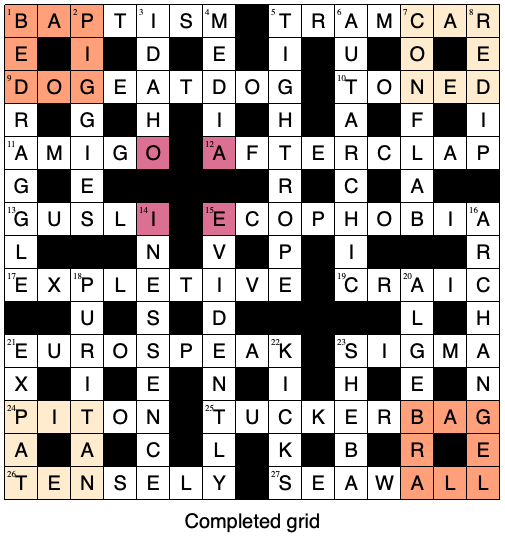
Assembling the five squares to create two cubes looks like this:
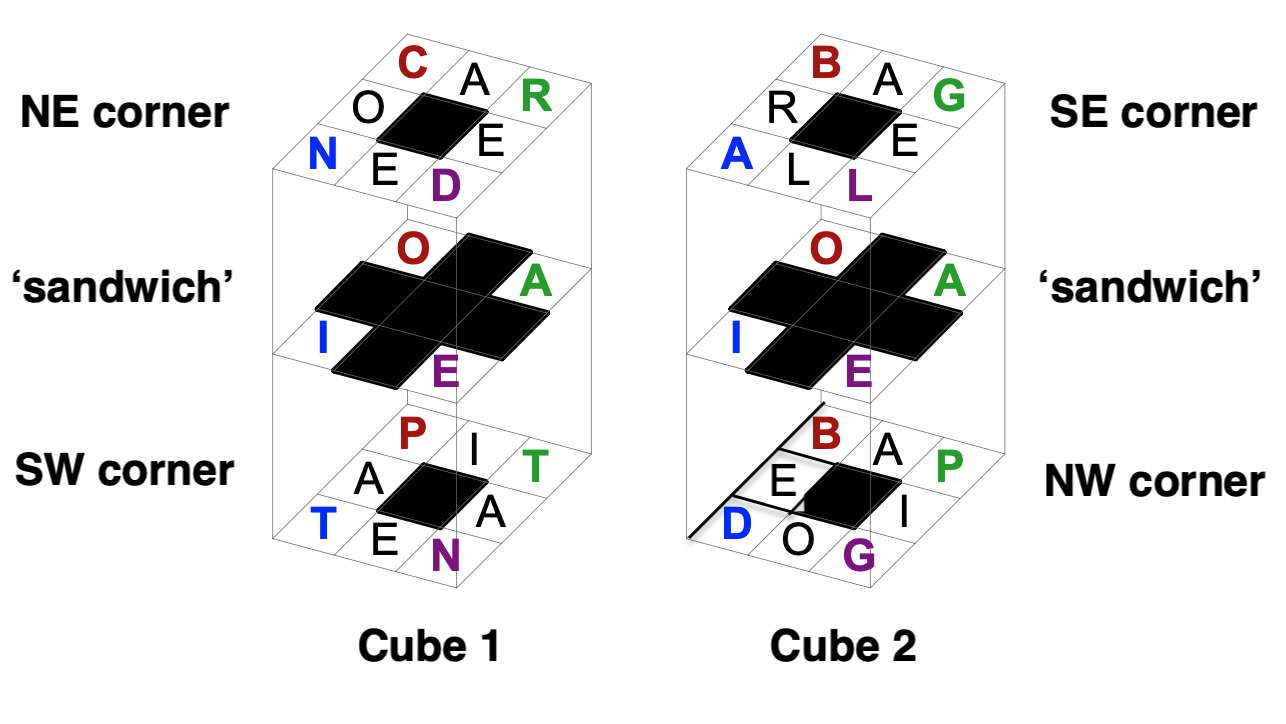
making the final eight vertical words, each with an appropriate synonym.
The 24 three-letter words and their synonyms are:
CUBE 1
‘TOP’:
CAR = MOTOR (13ac)
CON = STUDY (5ac)
RED = COMMUNIST (7d)
NED = HOOLIGAN (18d)
‘BOTTOM’:
PIT = MINE (19ac)
PAT = FLUENTLY (17ac)
TAN = BROWN (16d)
TEN = X (4d)
VERTICALS:
COP = POLICEMAN (1d)
RAT = SCOUNDREL (5d)
NIT = FOOL (1ac)
DEN = STUDY (26ac)
CUBE 2
‘TOP’:
BAG = SECURE (11ac)
BRA = SUPPORTER (3d)
GEL = SET (24ac)
ALL = EVERYONE (21ac)
‘BOTTOM’:
BAP = ROLL (20d)
BED = DIVAN (23d)
PIG = HOG (21d)
DOG = FOLLOW (12ac)
VERTICALS:
BOB = SLEIGH (14d)
GAP = OPENING (23ac)
AID = ASSISTANCE (10ac)
LEG = LIMB (15d)
When submitting the solution online, the eight vertical entries in alphabetical order are:
AID, BOB, COP, DEN, GAP, LEG, NIT, RAT
We are in awe of Pangakupu for his continuing inventive and prolific crossword output (we know him better as Phi – the regular ‘Phiday’ setter in the Indy), but we did notice that ‘at sea’ is used twice as an anagrind (in 12ac and 25ac) and ‘upset’ as a reversal indicator (in 3d and 21d) – very minor quibble in an otherwise inGenius puzzle!
In the parsings of the clues below, redundant words are [in green square brackets], and definitions are underlined
APT (liable) following B (bishop) + IS M (married)
A reversal (‘backed’) of MART (market) + CARe (concern) missing (‘eliminating’) ‘e’ (European)
DOGE (Italian magistrate) + D (first or ‘initial’ letter of ‘dressed’) in an anagram (‘swirling’) of TOGA
TD (‘Teachta Dala’ – Deputy to the Dail – ‘Irish politician’) round (‘securing’) ONE
A M (million) I GO (leave)
An anagram (‘at sea’) of PALE CRAFT
Hidden (‘found’) in pioneerinG US LIbrary – a new word for us
OP (work) in EC (city) HO (house) BIAs (inclination) missing the last letter (‘reduced’)
EXamPLE (‘illustration’) missing ‘am’ (morning) T (time) I’VE (I have)
An anagram (‘crashed’) of CAR + I C (see)
A reversal (‘backing’) of SORE (annoyed) round U (university) + PEAK (maximal)
A reversal (‘recalled’) of AMIS (English author) round (‘including’) G (good)
A reversal (‘push back’) of NO TIP (point)
TUCK (cram) + an anagram (‘at sea’) of BARGE
ELY (cathedral) after TENS (decades)
SELL (disappointment) round (‘touring’) AWAy (on holiday) missing the last letter (‘not quite’). We had to check the meaning of SELL.
An anagram (‘curiously’) of GARBED + an anagram (‘broken’) of LEG
I (one) GettinG (missing the middle letters – ’empty’) ‘tucking into’ PIES (desserts)
I + a reversal (‘upset’) of HAD + O (over)
A reversal (‘rising’) of AID (support) after ME (‘the writer’)
TIGHT (drunken) RE (about) round (‘accepting’) OP (work)
AU (gold) TAR (black) CHIC (fashion) – another new word for us
CON (Conservative) LAB (Labour) – ‘two parties’ round F (fellow)
EnD missing the middle letter (‘heartless’) in RIP (rough sea)
IN E (last or ‘ultimate’ letter in frame) + an anagram (‘wrecked’) of SCENES
EVIL (bad) Y (year) round (‘receiving’) DENT (damage)
ARCH (part of bridge) GEL (set) round (‘including’) A N (new)
I (independent) TA (thank you – ‘cheers’) inside (‘cracking’) P (first letter or ‘top’ of Portland) URN (vase)
An anagram (‘preparation’) of BAGEL + bReAd missing (‘ditching’) the odd letters
A reversal (‘upset’) of TAPE (video) round X (‘microblogging platform’)
KnICKS (underwear) losing ‘n’ (last letter of inhibition)
SA (sex appeal) round (‘enthralling’) HEB (Hebrew)
Thanks Pangakupu for the challenge, and thanks Bertandjoyce for an outstanding blog!
After KGB’s 2D puzzle in puzzle (#274), Pangakupu has elevated this to the next level.
I hope we stop here, and not get into 4D crosswords.
I was lucky to access the pdf with the right grid and clues, thanks to folks at a different forum.
I got the 24 words, I drew the 3X3 diagrams of NE, SW, SE and NW.
Then, I drew an imaginary line connecting the corner letters of SE/NW to get the missing four words, BOB, GAP, AID and LEG, thus identifying O A I E that formed the fifth block.
Doing the same thing to the SW/NE groups of words, yielded the other four missing words, COP, NIT, RAT and DEN.
Innovative, yes, enjoyable, maybe.
I thought this puzzle sounded harder than it turned out the be, but it’s probably because the instructions can be ignored until after solving the clues except for the part about the extra words. I liked the minimal entry requirements which made the puzzle seem quite mysterious before I looked at the pdf because the entry form page lacked the instructions to understand why there were only eight words to be entered. I must have printed the puzzle after it was amended because I only knew it had been when I saw the message about it when submitting my entry.
I had worked out that the sandwich layer had to be centred on one of the two black crosses in the grid but I thought it would be harder to find the top and bottom layers because there were so many 3×3 blocks of eight white squares surrounding a black one, but while I was filling the grid I noticed that those in the corners of the grid seemed to be the only ones that contained four real words. I only noticed that ‘Study’ appeared twice as an extra word when I was matching the extra words to the cube entries at the end.
Thanks, Bertandjoyce and Pangakupu.
I’ve come straight to the comments without reading any further than your introduction because, after an entire month of frustration and a very scribbly sheet, I went to the site to print off a clean copy. Lo and behold, the grid had changed and the words actually fit. Still have a few words to go, and have not worked out the cube thing yet, so, off to have some fun! Really thought I was losing my touch.
I echo Matthew@2 – it looked impenetrable at first, but we found the clues not to be too hard, so it ended up among the easier Geniuses. As always, the genius lies with the setter in compiling this intricate puzzle. Presumably, adding a Maori nina was too much, although for all I know, there is one of those too.
Congratulations on an outstanding blog! It will be my turn to blog this month’s Genius, to be published tomorrow, and I can only hope that it doesn’t require the sort of 3D graphics you have employed in this blog, as my blogging skills are not at that level.
I had the same experience of printing out the wrong grid before discovering the Guardian’s error; I would have expected some sort of error message on the crossword home page, but apparently that wasn’t considered necessary.
Incidentally, we still don’t know who won the prize for the special Genius puzzle published to mark the 30,000th puzzle.
Only my third attempt at a Genius and must be getting better as I used the dictionary rarely if at all for this one.
Could see the corner faces as the puzzle was going on and so it turned out that was exactly what was needed for most of the cubes. I don’t know if it’s the way my brain is wired but I had a hard time picturing the 3-D shapes so I ripped off some strips from my spare printout (a rare time a didn’t use it) and flimsily built them. It wasn’t too long then until the four vowels revealed themselves. Good fun and a bit of bonus craft as well.
Thanks B&J and Pangakupu
Not often I do a setter’s blog on a Guardian Genius puzzle but there’s one here: https://phionline.net.nz/setters-blogs/guardian-genius-june-2026/
I think there should be a campaign to get AFTERCLAP used more often.
Thanks Phi!
Thanks for the puzzle, blog and background info. It’s great to see some innovation and I hope the idea does get developed further.
All done now. Boy it was easier with the correct grid. Grauniad indeed! Once all the words were in, the four corner 3 x 3s became obvious. After realising the middle layer had to be the O A I E block, the rest fell into place. I couldn’t work out where NIT came from, as I had DEN twice from the two clues containing the redundant ‘study’. Thought ‘fool’ was CON, so didn’t reconsider it for NIT.
I am very impressed with the diagram above. I was a mathematics teacher, but I struggled to visualise how the 3D puzzle could be represented. Like Staticman 1@6 I considered cutting up squares of paper and stacking them. Took a 2D approach in the end.
Thanks for a fantastic blog Bertandjoyce. “Sell” for disappointment was new to me too but finally decided it couldn’t be anything else. Really enjoyed this, for the clues themselves and the gradual eking out of the final 3D construction (which felt like a very different workout) and original grid fill – I needed to think in 3D and then work backwards to get the full list of redundancies. I did consider trying to get hold of some small wooden cubes to attempt an actual construction but in the end my limited artistic skills and careful reading of the conditions sufficed. Thanks Pangakupu.
PS thanks also for the link to your blog, gives an idea of the amount of effort required to set these puzzles, and i am now intrigued by the legal issues connected to the anniversary puzzle, did Trump demand a review? that would be an afterclap and a half!