Ploy has been setting Listener crosswords since 2003 but it is his lovely ‘Right and Left ‘of just ten years ago that is the most memorable for me.
That grid depicted honeysuckle and bindweed climbing a doorframe, winding in opposite directions in the manner of the Flanders and Swann song.
So what have we here? An astonishing first preamble sentence. What courage to take on such a challenging device! ‘To enable solving, each clue needs a word in the definition to be unjumbled with one etter removed’. Those removed letters were going to instruct us how to cut along grid lines and 4,4, (interposed) would tell us where to start cutting.
Friends sailed through this solve and found it gentle and generous. With my loathing (and total incompetence with) jumbles, I really struggled. That little two-letter word SH leapt out at me ‘With loud cuckoo gone, should be linnets (2)’ I removed LOUD* from SHOULD* and saw that the definition was ‘Be silent’ so the system to use was clear, but how I struggled with ‘Where tipple is drunk in part of nursery (11)’ Of course the clue confirmed Ploy’s retention of his Listener oenophile membership, as did the ‘beer density’ in 20d, “Cheers Ploy!”, but the anagram gave WHIPPLE TREE and all I could extract from the ‘nursery’ was another N, to give Surrey. (Yes, I see now that it is in a Canadian Surrey!)
EASTER almost appeared in the grid but how on earth did Ploy manage to find the extra letters he needed to give, for example, SINARCHIST, producing CHRISTIAN with an extra S? Fortunately for this Numpty, where jumbles are concerned, the wordplay would give a solution, like ‘little interest over tax officer = IN TOTO’ leaving me to work out that ISONOMIES gave ‘OMISSION’ with an extra E.
The circled letters (yes, another jumble) spelled HTPRYOSAAG. That could only be PYTHAGORAS and we are told that his name is associated with the theme.
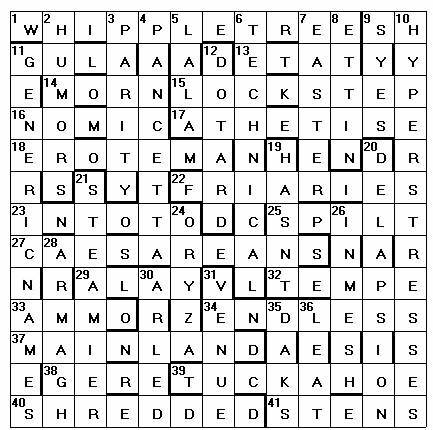
So we had the grid: and a series of letters that clearly told us in what direction to cut as well as the words EDGE/ BARS instructing us, probably, to begin our cutting where the bars met the edge of the grid. Yes, there were just four of those.
We were told to cut:
NNNNNEEEEE EDGE ESESESESESESESE BARS SSSSWWSSSS.
The ES ES ES were clearly creating a staircase effect and this is how it worked out: we had to carefully cut along those grid lines and reassemble those three pieces, keeping that little square as a memento of an astonishing compilation.
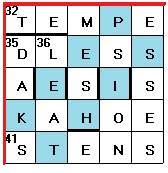
Google’s AI (co-solver) tells me that Henry Dudeney’s elegant geometric solution for dividing a 13×13 square into four distinct pieces that can be rearranged to form a 12×12 square and a 5×5 square was first published as “Another Patchwork Puzzle” (Problem 175) in his 1917 book Amusements in Mathematics. It serves as a visual, grid-based proof of the Pythagorean theorem. That’s all clear then!
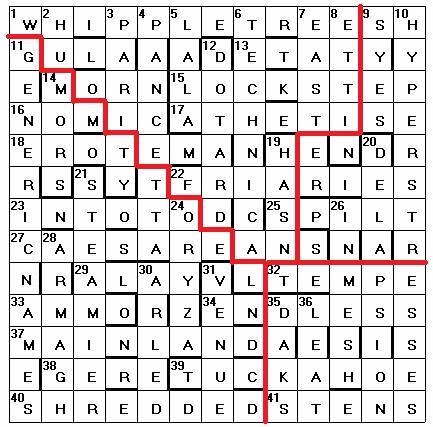
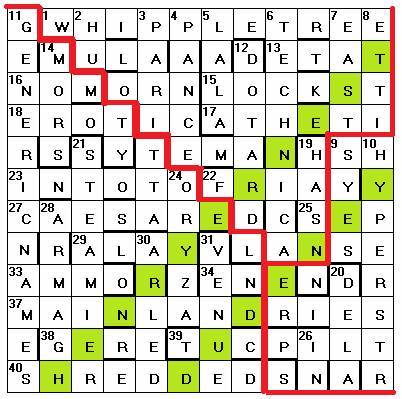
The other Listener blogger commented ‘The beauty of the puzzle is that the clues depend on rearranging a reduced word to make another and ditto the grid. I presume Ploy was able to use Qat or similar to build a list of the word pairs and then looked for synonyms that would build a grid within the constraints the puzzle needed. Quite remarkable really.”
I can only agree! Thank you Ploy.