Some brilliant clues in this week’s plain puzzle.
I’m never wholly confident about attributing the & lit label to a clue, but there are three clues in this puzzle which I think justify the description: 7, 10 and 16 down. 7 down is remarkable in another way – I don’t think that I’ve ever seen a 12-letter word clued as a hidden word before, and in this case it’s reversed as well. Although there is still no sign of a clue-writing competition, solvers can have no cause for complaint while Gemelo is in this sort of form.
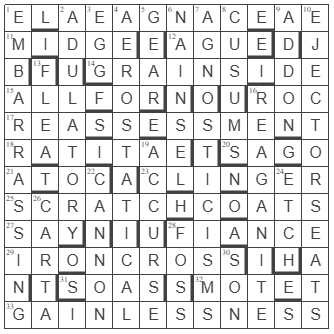
| ACROSS | ||
| 1 | ELAEAGNACEAE |
Tree and shrub family aged a decade, and led to change without any dead (12)
|
| *(AGED A DECADE AND LED) (omitting all the instances of the letter D(ead)). | ||
| 11 | MIDGE |
Fly westward for one tenth of a dollar, just about (5)
|
| E G (for one) DIM(e) (10 cents) (all rev). | ||
| 12 | AGUE |
Malaria epidemic putting paid to P&L (4)
|
| (pl)AGUE (epidemic). | ||
| 14 | GRAIN SIDE |
Where hair’s removed from showers I’d taken in middle of engagement (9, 2 words)
|
| RAINS (showers) I’D inside (enga)GE(ment). The term refers to how leather is treated. | ||
| 15 | ALL FOR |
Unusual floral backing (6, 2 words)
|
| *FLORAL. | ||
| 16 | ROC |
Legendarily, one could pick up jumbo crossword, totally accurately, only taking seconds (3)
|
| Second letters of cRossword tOtally aCcurately; I got this from the definition and only worked out the wordplay when I came to write the blog. Of course, this being a 3-letter word, it is fully checked so some may have filled it in without ever actually solving it. | ||
| 17 | REASSESSMENT |
Another look at sensor seems mad when nothing’s gone missing (12)
|
| *(AT SENS(o)R SEEMS). | ||
| 18 | RATITAE |
Flightless birds sing with allure, extremely attractive (7)
|
| RAT (sing, as in grass) IT (sex appeal or allure) A(ttractiv)E. | ||
| 20 | SAGO |
Talk about old product of palm tree (4)
|
| GAS (talk, rev) O(ld). | ||
| 21 | ATOC |
Skunk going through potato chips (4)
|
| Hidden in “potato chips”. | ||
| 23 | CLINGER |
Leech about to hang on (7)
|
| C (about) LINGER (hang on). | ||
| 25 | SCRATCH COATS |
First applications when decorating small crib no longer accepted in other cribs (12, 2 words)
|
| S(mall) CRATCH ( archaic dialect term for a manger or crib), A(ccepted) in COTS. | ||
| 27 | SAY |
Old woollen fabric, for example (3)
|
| Double definition. | ||
| 28 | FIANCE |
Country getting rid of king for one who’ll join union (6)
|
| FRANCE with I (one) replacing R(ex). Arguably “one” in the clue is doing double duty, but you could omit it from the definition so that “who” is a pronoun on its own. | ||
| 29 | IRON CROSS |
Offensive decoration not really meant to put out independent Scotsman? (9, 2 words)
|
| IRON(i)C (not really meant); ROSS (Scotsman). I think that “offensive” here is used to denote the fact that the Iron Cross is a military honour. | ||
| 31 | SO AS |
If only slogans could be regularly forgotten – likewise slow ads (4, 2 words)
|
| Two ways of hiding the letters alternately: SlOgAnS and SlOw AdS. | ||
| 32 | MOTET |
Choral composition came together without religious text (5)
|
| OT (Old Testament) inside MET (came together). | ||
| 33 | GAINLESSNESS |
Butcher sensing sale’s unprofitability (12)
|
| *(SENSING SALES). | ||
| DOWN | ||
| 1 | EMBARRASSING |
Stop scraping around section that’s awkward (12)
|
| EMBAR (stop), S(ection) inside RASING (scraping). | ||
| 2 | ADULATORY |
Fulsome man perhaps gaining year, one way or another? (9)
|
| ADULT (man) overlapping with A(nnus) OR Y(ear) (two abbreviations standing for “year”). The misuse of the word fulsome is one of my pet bugbears: the first definition in Chambers is “sickeningly obsequious” but it’s all too often used (with “apology”) to mean something like “lavish”. | ||
| 3 | EGG |
Bomb with long pins lacking shell (3)
|
| (l)EGG(y) (with long pins!). | ||
| 4 | AEROSTATICAL |
Upset Los Angeles citizen in painful argument, initially about ballooning (12)
|
| LA CIT (Los Angeles citizen) AT SORE (painful), A(rgument) (all rev). | ||
| 5 | GEAR |
Good part of cereal first? (4)
|
| G(ood) EAR (part of cereal). The question mark indicates that this is a definition by example: first gear. | ||
| 6 | NAINSEL |
Scottish Highlander is embracing nationalist during unproductive uprising (7)
|
| N(ationalist) inside IS, inside LEAN (unproductive, rev). | ||
| 7 | AGNOSTICISMS |
What contributes to rising skepticism [sic]? It’s on gaining empiric beliefs (12)
|
| Hidden and reversed (“rising”) in “skeptiism sic its on gaining”. Quite brilliant! | ||
| 8 | CUSUMS |
Copper, say, puts two and two together in language-based analyses (6)
|
| CU (copper) SUMS (puts two and two together). | ||
| 9 | ADD-ON |
Extra active duty to get into (5)
|
| AD (Active Duty) DON (put on, or get into). | ||
| 10 | EJECTOR SEATS |
Ultimately, people on planes, accepting cost, are thrown out – in these? (12, 2 words)
|
| (peopl)E, *(COST ARE) inside JETS (planes) & lit. Another piece of brilliance. | ||
| 13 | FLEA |
What takes blood, mainly? (4)
|
| I think that this parses as FLEA(m), a fleam being a lancet used to bleed diseased cattle. | ||
| 16 | REAGANITE |
Largely anti-Green American, possibly? (9)
|
| *(ANTI GREEN). Another & lit, although Green politics were not really prominent when Ronald Reagan was active in politics. | ||
| 19 | ACCURSE |
Damn accountant with unopened contract (7)
|
| ACC(ountant) (p)URSE (contract). | ||
| 22 | CANNON |
Gorge, eating new batter (6)
|
| N(ew) inside CANON. | ||
| 24 | ETCH |
Cut, and others like it, beginning to hurt (4)
|
| ETC (and others) H(urt). | ||
| 26 | CARTA |
Chief accountant concealing crafty conduct in formal writing (5)
|
| ART (crafty conduct) inside CA (Chief Accountant). | ||
| 28 | FOSS |
Moat with waterfall (4)
|
| Double definition. | ||
| 30 | SON |
Disciple, like priest, ignoring peripheral parish (3)
|
| (par)SON (priest). Given that par. is a recognised abbreviation for “parish”, I’m not quite sure if we need “peripheral” in the clue. |
16 down: ANTI-GREE(n)+A
anagram
I think 16d is an anagram of ANTI-GREE(n) [“Largely anti-Green”] and A [= American]. On that basis I agree it’s an &lit. In 7d “empirical beliefs” appears to be a definition that has no role in the wordplay, so not an &lit in my book. 10d can probably be counted as an &lit but I am not convinced of its brilliance because it conjures up a rather strange picture: what cost are people accepting, and why would you then throw them out of a plane?
A clue I have sometimes cited to people who are not sure what an &lit is is this one by Don Manley, quoted by Colin Dexter in Cracking Cryptic Crosswords: No fellow for mixing (4, 4). Read as wordplay, the clue suggests an anagram of “No fellow”. Read a second time as a definition it suggests someone who does not mix. Answer: LONE WOLF, of course.
Many thanks for the blog.
Apologies to Luciano for the slight overlap.
Good job on the blog. I find it remarkable that Gemelo has eight 12-letter words intersecting.
Thanks for the blog , another excellent Plain puzzle with many fine clues . Unusually I put 1Ac in last , too many A’s and E’s to be sure .
EMBAR from 1D is listed as archaic in Chambers93 , it may have modernised since then .
CUSUMS not in Chambers93 , I have seen it in Azed and it is used in Astrophysics .
&Lit – 7D agree with Hector@3 , two words at the end not in the wordplay . 10D I disagree with Hector@3 for the same reason . REAGANITE definitely and very good .
It would be good to have some compound anagrams in these puzzles .
Oh dear, I think I’m backsliding. Last two weeks I’ve got nowhere near finishing Gemelo.
30dn: “peripheral parish” is ignored in parSONish (like priest).
Some excellent clues. CUSUMS not in my dictionary and I couldn’t see from Google where “language-based” would come into the definition? It seemed to be to do with statistics (deriving from cumulative sums, I assume). Perhaps someone who knows about these things could explain.
Also, agree with Roz@6 about 7dn and 10dn.
Thanks for the great blog.
MunroMaiden @8 , I like your parSONish better , must admit I only glanced at this clue once the letters were in .
You have the right idea for CUSUM tests , they pick up small variations over time in a nearly constant background , such as the solar flux . I can see how they would be used in languages to detect small changes over time .
Roz@6:I don’t think you’ll be surprised to hear that EMBAR is still archaic in Chambers 2016 (whereas the alternative IMBAR is labelled obsolete). CUSUM makes it into the 2016 edition.
Thanks Hector@10 , EMBAR should have had some indication of this , Gemelo seems to follow Azed in doing this normally .
I thought the definition of ROC was pretty clever once I saw where it ended and couldn’t believe I missed the reverse hidden AGNOSTICISMS for so long. I originally entered FLEA from the definition and had to look in Chambers to find FLEAM; I assumed this clue was supposed to be &lit, and my online searches suggest that flea larva eat things other than blood. I first though of PARSON for 30d but eventually came up with PARSONISH as mentioned by MunroMaiden@8.
Hector@3: In my mind the people using ejector seats are normally the pilots of military planes, so I thought they could be accepting the cost of the plane crashing once they have ejected.
Thanks, bridgesong and Gemelo.
Agree that this was one of Gemelo’s best efforts. The only doubt I had was the ‘say’ in 8dn, which seems unnecessary: copper is quite definitely Cu; there’s no question of a definition by example. [Sorry, Wil Ransome. I was logged in to 15^2 under my blogging name. It doesn’t seem to allow me to alter the author of the blog.]
C2016 defines CUSUM as “a statistical technique that attempts to identify individuals by their characteristic use of language.” That accounts for the definition but, as often happens, C is off the mark on a technical word.
John@13 – I thought the “say” maybe referred to “puts two and two together” as that would be an example of a sum.
TimSee@14: that’s interesting. I was at a loss to see how the online definitions I’d found for CUSUM, which involved mathematical quantities, could appy to language analysis. A bit of Googling turned up: “the CUSUM technique was promoted in the late 20th century to detect unique writing habits” eg to identify authorship or forgeries – but it has apparently been heavily discredited, as it fails to produce reliable distinctions. Odd that Chambers proffers one example of its use – and a bad one at that – rather than defining the technique itself.
Yes thanks MunroMaiden@15 . You’re quite right. I’d misattributed the ‘say’.