Time for another Inquisitor from Nathan Panning.
The Preamble:
This puzzle is inspired by the old riddle where two doors are blocked by two guards, of whom one always tells the truth and one always lies. Here, each clue is really two clues written by two guards: the definition is true in one clue and a lie in the other. Solvers must determine which guard’s clues lead to answers in the left hand side of the grid, and which guard’s clues lead to answers in the right side. Answers 7, 9, 15 provide a yes-no question that one of the guards answers ‘no’. Depending on whether its unchecked squares are filled, 20 will be either a description of a guard or a statement of an ability solvers have using 7, 9, 15.
Where do we start?
We decided that we would add LIES to the left and TRUE to the right knowing that we could always print out another grid if we were wrong. Thankfully, we realised we were correct when the entries for 7 made sense.
We blogged the last Nathan Panning IQ which we really enjoyed – the clues here were again not as daunting as we first thought. Although we had never heard of LURS (trumpets) and guessed at WHEYEY, the clues were clear and accessible.
Our FOI was THESIS which needed checking in Chambers as we were not aware of the musical term. DAWNED followed fairly quickly and we were then well on the way to filling all the connecting down clues.
Across the bottom, we had CAN ID ENTRY – a description of what ability solvers have knowing the answer to the question in 7, 9, 15.
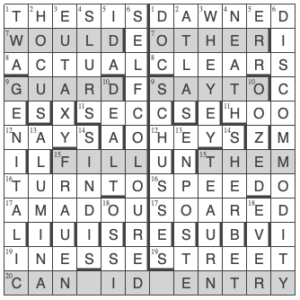
We then read the preamble again. The old riddle of two doors relies on you asking one of the guards a question about how the other guard will reply. You know what choice to make as you always have to do the opposite of what they say. As the guard says NO to filling them in we chose CANDID SENTRY as the entry.
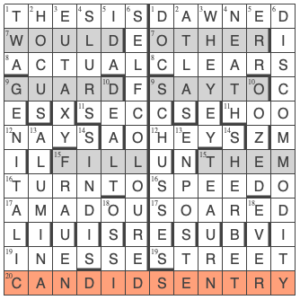
So, not as complex as we first thought when we read through the preamble but great fun. An original idea which was well executed. Thanks Nathan Panning. Here’s to the next one. We hope we don’t have to wait too long.
| ACROSS | |||
| No. | LIE | TRUE | |
| 1 | THESIS | DAWNED |
Upbeat article sibling began with two points to occupy father (6, 6)
|
| THE (article) SIS (sibling) – a thesis is a downbeat in music – opposite of ‘upbeat’ / W NE (two points on the compass) inside (‘occupying’) DAD (father) | |||
| 7 |
See preamble
|
||
| 8 | ACTUAL | CLEARS |
Faked performance for two old pence off wipes to break off scale right (6, 6)
|
| ACT (performance) |
|||
| 9 |
See preamble
|
||
| 11 | SEC | HOO |
Will’s cry: “Who said Mo is sweet?” (3, 3)
|
| A homophone (‘said’) of WHO – a Shakespearean word / SEC (second – ‘mo’) – opposite of sweet | |||
| 12 | NAYS | HEYS |
Nationalist American lost city votes, favouring rural motions POTUS announced (4, 4)
|
| N (Nationalist) A (American) YS (mythical city off the coast of Brittany that was swallowed up by the ocean) – opposite of ‘votes favouring’ / A homophone (‘announced’) of HAYES – a former President of the USA | |||
| 15 |
See preamble
|
||
| 16 | TURN TO | SPEEDO |
I will leave Italian city tour half way, stop working, dial sportswear company (6, 2 words, 6)
|
| TUR |
|||
| 17 | AMADOU | SOARED |
Rose reportedly cut flame retardant in pyjama, doubtfully (6, 6)
|
| A homophone (‘reportedly’) of |
|||
| 19 | IN ESSE | STREET |
Unrealised skill, missing first way setter puzzles (6, 2 words, 6)
|
| 20 |
See preamble
|
||
| DOWN | |||
| No. | LIE | TRUE | |
| 1 | TWA | DOC |
One in Scotland stopping partway to provide canine bones (3,3)
|
| Hidden (‘stopping’) in parTWAy – Scottish for ‘two’ not one / DO (to provide) C (canine) | |||
| 2 | HOCUS | ATLAS |
Be honest – this leads to us being burdened by the weight of the heavens, finally, finally failing (5, 5)
|
| HOC (‘this’ in Latin) US – to cheat – opposite of ‘be honest’ / AT LAS |
|||
| 3 | EUTAXY | WHEYEY |
Pale detective getting into why Brussels reported cab chaos (6, 6)
|
| EYE (detective) inside WHY / A homophone (‘reported’) of EU TAXI (‘Brussels cab’) – good order – opposite of ‘chaos’ | |||
| 4 | SLURS | NEATH |
Welsh town bard’s inferior to soprano and trumpets’ staccato effects (5, 5)
|
| A poetic word (bard’s) for inferior / S (soprano) LURS (trumpets) – smooth or legato effects in music – opposite of ‘staccato effects’ | |||
| 5 | IDA | ERR |
Midas stripped in legendary river: task to scrub and put one’s foot in it (3, 3)
|
| 6 | SELF-COLOURED | DISCOMMODITY |
Byzantine double fresco with length not breadth, painted representing city’s dim mood in trouble (12, 12)
|
| An anagram (‘byzantine’) of DOU |
|||
| 9 | GENITALIC | SCHUSSES |
Sexless general of a right- leaning type running USSR chess loses rule and goes downhill fast (9, 8)
|
| GEN (general) ITALIC (‘of a right-leaning type’) – opposite of ‘sexless’ / An anagram (‘running’) of USS |
|||
| 10 | DEALT | OOZED |
Enjoyed liquor bar opening; moved slowly, as liquid was given beside alternative sandwiches (5, 5)
|
| 13 | ALUMINA | EN POSTE |
Soft mineral, one in possession of former student living as a diplomat, sent abroad with Poe (7, 7, 2 words)
|
| I (one) inside (‘in possession of’) ALUMNA (former student) – a hard mineral, not ‘soft’) / An anagram (‘abroad’) of SENT and POE | |||
| 14 | SINDIS | SHERBET |
Juice drink made sharp with aromatic plant in to offend and disrespect Chinese people (7, 6)
|
| SET (made sharp) with HERB (aromatic plant) inside / SIN (to offend) DIS (to disrespect) – people from SE Pakistan, not China. We had never come across set = ‘to sharpen’ before | |||
| 15 | FRAUEN | TEA URN |
Brewer’s ugly nature: “German men are fun to mess with” (6, 2 words, 6)
|
| An anagram (‘ugly’) of NATURE / An anagram (‘to mess with’) of ARE FUN – Frauen are German women not men. | |||
| 18 | OSSI | EVER |
On record, apple-eater maybe writing 20% off Bolognese or Hamburger? (4, 4)
|
| EVE (apple eater) R (writing as in the three Rs) / OSSI |
Much enjoyed; it brought back happy memories of being introduced to those logic puzzles in Martin Gardner’s books long ago. Nothing to add, really, other than that I waited until I had one of the clues that fit on only one side (14D) before assigning the naughty and nice halves of the grid. Luckily I remembered “set” = “sharpen” from Dorothy Sayers’s Have His Carcase, where a razor and its maintenance provides an important clue.
Many thanks to Nathan Panning and Bertandjoyce.
Well, I completed the grid, and picked up the possibility of a CANDID SENTRY, but I wasn’t very sure what CAN ID ENTRY was meant to mean, nor why either guard would be expressing an opinion, true or false, about whether or not I should fill in 2 squares. I compromised by filling them in pencil, wondering what I was missing. I enjoyed the true/false device and thought the clues were fine; just a bit puzzled by the end game. Thanks to Nathan Panning and Bertandjoyce.
Thanks for the blog to a very neat puzzle. One minor point – I think the homophone in 17a is SAWED for cut rather than SWORD.
Thanks Skikasta – well spotted! Blog corrected.
Interesting that the lies were easier to spot than the trues!
I enjoyed the challenge of the double clues and the unfolding hidden phrase although, like Sagittarius @2, I was convinced there was more to the end game and was looking for something more to fill in. I gave up and was glad to find there wasn’t anything I missed.
Thanks to Nathan and Bertandjoyce
This looked pretty daunting at first. But helpfully the two 9 downs were of different length and SCHUSSES leapt out at me (my skiing is going downhill fast). Also the 12-letter clues were mercifully straightforward, which also helped things fall into place. A couple of cool new words for my vocabulary (EUTAXY, AMADOU), and overall an enjoyable challenge – I also plumped for “Candid Sentry”, although I briefly flirted with the idea that Cerberus might be somehow involved. Thanks to NP for the puzzle and B&J for setting it all out.
Comment #7
Someone asked where you could find the puzzle. It is only available in the print version or on line for subscribers.
Still a bit puzzled where we were supposed to get the D and S from, other than if you happen to think of them, they make words that are a bit relevant, if you squint. There’s no real “click” there. Did I miss something?
Thanks everyone for solving and commenting and especially to Bertandjoyce for the blog and kind words.
To clarify how I intended the endgame:
– you initially don’t know what to do with the cells in row 20
– there are 2 options: if you leave them blank it says CAN ID ENTRY (ie ‘you can identify what the competition entry should be’, an ability solvers have); if you fill them in it says CANDID SENTRY (a description of one of the guards)
– as with the traditional riddle, you have to work out which by asking a question of the guards
– when you ask ‘Would [the] other guard say to fill them?’ and get answer ‘No’, then the correct answer must be ‘Yes’, and you should fill them
I’d intended the ‘lie’ for IDA to be that Ida is a legendary mountain, not a river; I didn’t know the real river but that works too!
Nathan Panning (Richard F)
I enjoyed the puzzle setup very much but like others was perplexed by the endgame. I actually thought “CAN ID ENTRY” was meant to be read as “Can (=bin) 1 down entry” which didn’t seem quite right but was the best I could do!
I did get to CANDID SENTRY but wondered why there wasn’t a bar in the grid between CANDID and SENTRY.
So a slightly unfulfilling ending but a really fun, fair and novel setup. Many thanks to all!
As a friend pointed out, the analysis @10 seems to assume that the guards know whether or not we are to fill the empty cells.