Classic IO.
I enjoyed this very much. IO always poses a tricky challenge, and this is no exception. The trickier the mental workout, the greater the sense of satisfaction when the penny drops.
If you have a slightly different take on the parsing, do leave a comment. Many thanks to the setter.
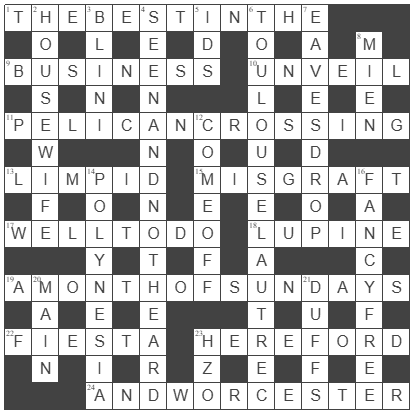
THEBES (old city) needs TIN (money); ([b]U[t] (essentially + SIN (wrong)) to dig THEBES (it again) + S (son)
VE[t] (examine) parts UN[t]IL (before); (two Ts (tenors) retiring)
PING (system test) involving (ELI (Sam’s teacher, biblical) + CAN (may) + CROSS (block))
LID (hat); (I’M (one’s) + P (pastor)) is wearing
M[oorfield] (‘s chief) + IS + T (tense) keeping GRAF (count)
‘Graf’ is a German title of nobility equivalent to a count
Cryptic definition
A well is also a source of oil, and a ‘to-do’ is a scuffle
UP (completely) blocked by LINE (row)
For ‘up’ think ‘drink up’ or ‘use up’ to mean ‘completely’
OF (during); (MANY THOUSANDS)* (*wandering, around)
[sel]FIES TA[ken] (to capture)
(WASN’T RECORDED)* (*sadly); (HERE (where I am) + FOR (because of)) launches
In (HOW (which style) + I); USE (habitually employ) + FE (iron) – &lit
BLIN[d] (undiscerning, D (day) not observed) + I (institute)
Cryptic definition
“SCENE” with/and “KNOT” (“heard”)
Double definition
I.D.s (to check someone’s identity); Iain Duncan Smith, Tory leader often referred to by his initials
(TORTUOUS CLUE)* (*edited) + ELA (what Morse needed to think about) entering
ELA = English Language Arts; Morse having invented a ‘language’ system
DAVE’S (channel’s, cycling); PORE< (opening, <up) tours
The UK has a television channel called ‘Dave’
“MEAN” (humble, “broadcaster’s”)
COMF[y] (completely at ease, almost) with FOE< (adversary, <retired) in
(IS OPENLY A)* (*deviant)
(N (new) CAFE FRY)* (*up) with [t]E[a] (unlimited)
Cryptic definition
MA IN is the opposite (counter) of POP OUT
Double definition
20 (all fingers and toes maybe) submerged under H (hot)
IO includes a number in the grid – controversial!
It’s a Z in the grid image as numbers aren’t accepted in my solving tool…
Dave changed its name to U&Dave more than 2 years ago so 7d is a bit out of date.
Managed to finish but a few were only partially parsed (eg ELA in 6d) and needed help finding the old county.
Quite liked the number in H2O. There was an FT crossword some years ago with a nina along the lines ‘Cinephile is 90 years old today’ with solutions ‘satur9 (saturnine)’ and ‘ground 0 (zero)’ to give the ‘90’.
SEEN AND NOT HEARD was my favourite. Maybe Henri could have helped with some of the others, but Oriel puts it very well. It’s satisfying when you finally get there.
6D: I think the reference is to Inspector Morse, and the element of wordplay is ALE inverted (about). Morse would go to the pub to think about solving a case.
7D: I could not parse this. NHO Dave.
Thanks for a great blog , never easy to explain all of this .
The long entries helped a lot giving many letters and I found the definitions rather friendly .
6D: I agree with Cineraria.
15A: Solvers outside the UK might not know that Moorfields is a leading eye hospital (to which I have reason to be grateful).
I checked this after enjoying the usual IO quality-just to check if a 2 was acceptible as the ans was H2O
I never heard that using a numbers was out of bounds
Rock on JH!
Tough as always. Took an age to see H2O. I had the right thinking just couldn’t twig that it might be a number in the middle.
Favourite today BEST IN THE BUSINESS.
As is par for the course quite a lot not or partially parsed so thanks for the blog.
Thanks IO and Oriel
Well I wrote the intended character into every white square on the grid in one go and taking less than my self-defined “par” time to do it, but, frankly, I could not be bothered to work out all of the tortuous parsings. Thanks Oriel for doing the hard work.
2d reminds me of a clue in the Ximenes book The art of the crossword, which I first read over 50 years ago: I have most of the time to stitch, then I iron – HOU[r] + SEW + I + FE &lit.
Hovis @1 – not only is Dave outdated: so are Pelican crossings, which began to be phased out and replaced by Puffins in 2016. I dare say there may still be some “along the way” somewhere.
Well I got there but it was hellish and I had a lot of parsing gaps. On top of the tortuous wordplay some of the synonyms were super stretchy. Like COME OFF as ‘conclusion’ or FANCY FREE for ‘what’s not to like’. So this was an iffy one for me.
I got 16 answers today: well past my previous IO record of 10, and probably as close as I will ever get.
12dn Chambers 2016 p 314 has come-off n a conclusion.
Well it went in but I did think the parsing was too much like hard work. I’m surprised there has not been more controversy over the “H20” answer. Apart from anything else, the “2” is a numeral – a number is an abstract concept which could be indicated by “two” or “2”, but the former is a word and the latter a numeral. Another one of those losses of precision in language.
As I was forced to accept this had to be the answer I thought it a poor option to fill the grid this way. What next – punctuation marks? Answers consisting of emoticons? It’s a downvote from me for this “trick”.
Many thanks IO and Oriel for the masterful unpicking of it all.
Pelham Barton@12 OK but have you ever heard it in a sentence? I feel like saying ‘Come off it’!
Managed to complete with most parsed. Thumbs down for H2O I’m afraid.
It’s a molecular formula. Where would we draw the line? O3 for ozone, H2 for hydrogen? NH3 for ammonia?
An appeal to all editors – let’s nip this in the bud please.
Thanks Oriel and to IO (mostly)
Like PB @8 and JOFT @13, I filled the grid but left the longer Lego constructions in the cqba basket. Quite enjoyed it ntl, ta both.
I like H20 , something a bit different and the wordplay was very good .
I managed everything except H2O, I put HOO in and hoped for an explanation here. If I wasn’t feeling unwell I might have made the final mental leap.
Having a number in the grid is an interesting diversion and mirrors numbers acting as letters in clues but I hope it’s something editors will say NO2.
Agree with Roz. I would have thought that anyone attempting an Io must have solved thousands of puzzles and would be charmed by the novelty/cheekiness of H2O! A MONTH OF SUNDAYS was my other favourite today.
Thanks Io and Oriel for sorting out some of the trickier parsings for me
Fuddleduddy@14:
1. I do not claim to be able to remember every word and meaning that I have ever heard used in a sentence.
2. I do not claim to have heard every word and meaning in the English language, whether I can remember it or not.
3 and most important. Setters have access to printed dictionaries, they do not have access to the vocabularies of individual commenters.
I am happy to quote meanings from the dictionaries when they are relevant to the specific clues in a puzzle. It saddens me that I have to keep making these more general points, which I would hope should be thoroughly understood by all commenters.
Like PB, I found this rather easier than the usual IO to complete and enjoyed doing it, but gave up on some of the parsings. Many thanks to Oriel for filling in the gaps so admirably.
I also liked H2O for its originality. I’m never impressed by the “where will it all end” (or “thin end of the wedge”) argument. The job (or maybe art) of the setter is to make a puzzle that, however difficult, is solvable and fair. I’m perfectly happy to leave this to the setter’s judgement rather than having arbitrary rules imposed.
I wondered why pelicans need crossings, given they can fly. Then I researched the term and understood what they are. The UK road department must have a whole division devoted to animals and acronyms given its pelican crossings, puffin crossings, panda crossings and I am sure many more such things.
A point about the old county which risks becoming an argument about angels on pinheads is that the county (singular) was officially named “The Counties (plural) of Hereford and Worcester.” I lived there at the time and had to put up with this verbose appellation. It was, however, an improvement on the name originally proposed viz “Malvernshire”.
Unusually for Io it wasn’t too difficult to spot the definitions today so I was another one who got a fair few answers without being able to/bothering to parse them. Didn’t finish though as I struggle with Io.
Chuckle for H2O.
For HOUSEWIFE, I can’t make ‘which style’ = HOW no matter how I try. Doesn’t it need the ‘in’?
Martyn@25 don’t forget the zebras .
Managed to finish with the exception of H20. The best I’ve ever done with an Io. Several unparsed but overall feeling pleased that I’m making progress. A very good challenge (for me, at least).
I failed at PELICAN CROSSING, never having heard of the thing. There were several others where I couldn’t be arsed and I left them unparsed (an anapestic couplet for you there).
For those shocked by H2O, you need to start doing the Thursday New York Times. There is always a gimmick on Thursday, and figuring out the gimmick is part of the puzzle. You name it, they’ve done it. Answers that abruptly turn a corner. Several letters written in certain squares. Numerals. Symbols. Letters “written” in certain black squares. For the confused, there’s always an entry (usually the last long across light) that gives a hint as to what the trick of the day is.
I interpreted 6D the same as Cineraria #3 – Inspector Morse said he needed ALE to think – so “about” is ELA
Not happy with H2O. Opens the door too much leeway, methinks. The New York Times crossword allows for words in box or numbers or slashes for different letters – e.g S/W – where S is for Across and W for down. It is fun in a different way and also par for the course for NYT (I guess when it started out it may have been controversial) – but I don’t think it has a place in cryptics. There are enough things to be concerned about as it is.
Well, it went better than expected, altho some aspects of the parsing were above my pay grade, as per usual with IO, it’s good to be challenged every once in a while…
COME-OFF could be a conclusion in a “happy ending” sense, but I doubt that was the intention of our setter… I probably felt more aggrieved about “oil baron” = “well”, but the definitions did the bulk of the heavy lifting in this puzzle, which was a relief! The longer clues weren’t as unapproachable as sometimes, so a lot of friendly crossers helped the process… the water thing, I filled in as HHO, but obviously wasn’t acceptable to the app… the “cleverness” of the clue and the answer escaped me till I read the blog, more of an eyebrow raise for me… I’d have been happier if it hadn’t interacted with the county ..
Thanks IO and Oriel
WELL-TO-DO – I took it as one short phrase , a dust-up between oil barons could be a WELL , TO-DO . Not the best clue .
17ac: I agree with Roz@32 on the way this one works. Expanding slightly on the explanation, a dust-up between oil barons could be a TO-DO about a WELL, which then becomes a WELL TO-DO. This being a secondary (or subsidiary) indication, it does not have to fit the enumeration 4-2-2. There is no claim that “oil baron” defines WELL.
50% is a passing grade for me with an Io/Enigmatist puzzle. This time I got 78%; if that happens again I’ll have to redefine a pass. Thanks Io and Oriel for the humbling exercise, and thanks Roz for encouraging me to keep trying these uber-challenges.
One that I didn’t solve was 6d TOULOUSE LAUTREC, but on reading the blog and comments it became my clue-of-the-day.
4d held me up a bit because I always thought that children should be SEEN BUT NOT HEARD. It wasn’t until I got 13a LIMPID that BUT became AND.
4dn: For what it is worth, the form given in the Oxford Dictionary of Quotations 8th edition (2014, p 615) is “Children should be seen and not heard.” It is dated early 15th century and marked originally applied specifically to (young) women. Having said that, it seems to me to make just as much sense with either “and” or “but”.
Thank you, Io and Oriel.
In 4d, I took the answer to be “seen and not heard”.
I viewed ” in e.g. pub” as an indicator of ‘overheard’ or ‘sounded like’ ‘scene and knot’.
Not the location for their behavior which in my understanding was meant to be their preferred behavior all of the time.
Hugh@36 , your method would just give SEEN AND NOT .
The really clever bit in this clue is no indicator for a soundalike so we must infer that – scene with knot ? = SEEN AND NOT HEARD .
Thank you, Roz.
That makes more sense. I struggled to find use for “in e.g. pub” and thought it might mean “conversationally” or a similar indicator.