This week’s 11 x 11 crossword from the Guardian intended to teach cryptic crosswords, found here
This puzzle is the 12th Quick Cryptic from Dice, 14th including two paper only specials. This puzzle has anagrams and hidden word(s) with all the letters in the clues. The other clues, where the words and letters need to be found by the solver, are Spoonerisms, seen for the second time and last used in puzzle #16, set by Picaroon, and decapitations, a specific form of deletions, which we are seeing for the 8th time, last seen in puzzle #97 in February. Spoonerisms are usually clearly indicated, but that doesn’t necessarily make them easy, as spotting the puns involved can be a challenge. Dice always includes something extra: we have seen themes, a pangram and a Nina so far. This time we have a theme of food and drink.
The whole point of these crosswords is support and encouragement of new solvers, so special rules for these crosswords apply – see here – those rules include not posting solving times.
This blog was developed in response to suggestions. We hide the answers and the wordplay descriptions (parsing) too. To find the solution click on “Answer” and to find how the word play works, click on “Parsing” which will reveal the hidden information. You can choose to reveal everything using the “Expand All” button. If you have partially revealed the page, refreshing it will clear that, and allow you to expand all. The definition is in bold and underlined, the indicator is in red.
For additional help click here
There is a summary of the tricks used in the first six months here, if I ever stop for long enough, I’ll build another one, and a Guardian Crossword blog called the ultimate beginner’s guide has tips which may be useful for some solvers.
For abbreviations and clue tips click here
Fifteen Squared uses several abbreviations and jargon tricks, there’s a full list here, of which I’ve used the following in this blog:
- underlining the definition in the clue – this is either at the beginning or end of the clue
- indicators are in red.
- CAPITALS to indicate which bits are part of the answer, e.g. haVE ALtered for the example.
- anagram – letters being used shown in brackets (SENATOR)* for the clue below to give TREASON.
- anagram minus – letters being used are shown as capitals in brackets, with the unused letter in lower case and square brackets – so fluttering (OWLET[s])* becomes TOWEL.
- anagrind – anagram indicator – in the case below it is “arranged”
- soundalike – is indicated by “Wilde” – so in the example, Oscar “Wilde”, the playwright and author, is indicating the soundalike WILD.
- charades – the description below only gives the example of words being added together, but charades can be more complicated, adding abbreviations or single letters to another word. Examples previously used in this series are: Son ridicules loose overgarments (6) S (son) + MOCKS (ridicules), Get rid of dead pine (5) D(dead) + ITCH (pine) – D ITCH, and early on DR (doctor) + IVE (I have) to give DRIVE.
- reversals – the reversal element of a clue is indicated by < – so in the example clue below, VieTNAm <.
- CAD or clue as definition– where the whole clue gives the definition, sometimes called an &lit. These are rare.
- DBE or definition by example – e.g. where a dog might be clued as a setter – often using a question mark, maybe, possibly or e.g. to show that this is an example rather than a definition.
- surface – the meaning from reading the clue – so often cryptic clues use an English that could only be found in a cryptic crossword, but a smooth surface is a clue that has a meaning in English, which can be pointed or misleading.
TODAY’S TRICKS – from the crossword site – because the clues have moved on from the clue descriptions below, I am now adding more to the descriptions hidden above. Clues begin or end with a definition of the answer. The rest is one of these:
- Anagram Anagram of answer and hint that there’s an anagram
‘Senator arranged crime (7)’ gives TREASON (crime) - Hidden word(s) Answer hidden in clue’s words
‘Some haVE ALtered meat (4)’ gives VEAL. - Spoonerism Answer with words’ first sounds swapped
‘Spooner says rowers let slip sea creature (4,4)’
gives, via ‘crew blab’ (rowers let slip), BLUE CRAB (sea creature). - Decapitation Answer is another word without first letter
‘Beer in story without intro (3)’ gives ALE (beer) from [t]ALE (story).
| ACROSS | Click on “Answer” to see the solutions | |
| 1 |
Box of food was short of pizzazz, according to Spooner (6,5)
|
AnswerPACKED LUNCH |
ParsingSpoonerism (according to Spooner) from “lacked punch” (short of pizzazz). |
||
| 7 |
Rise and cast for fish (7)
|
AnswerSARDINE |
Parsinganagram of (RISE AND)* with an anagrind of “cast” to give this fish. “Cast” is usefully ambiguous word – cast as in casting seed as an anagram indicator, but it could be referring to a cast of actors. |
||
| 8 |
Trouble held by Pandora ill-omened (3)
|
AnswerAIL |
Parsinghidden word(s) (held by) in PandorA ILl-omened. In the clue trouble is a noun, but the solution uses a the synonym of the verb. |
||
| 9 |
Get on your knees, dropping head, bit of light shining through (3)
|
AnswerRAY |
Parsingdecapitation (dropping head) from [p]RAY (get on your knees) decapitated (dropping head), but the whole clue summons up an image of praying |
||
| 10 |
Spooner’s nickname for worker, one in hot water for drinking? (3,3)
|
AnswerTEA BAG |
ParsingSpoonerism (Spooner’s) a nickname is a “tag” and a worker is a “bee”, so the Spoonerism to consider is “bee tag”. There’s a question mark to indicate that the definition is cryptic. But the whole clue’s surface is another little visual story. |
||
| 13 |
Mark pig, says Spooner, for sausage sandwich (3,3)
|
AnswerHOT DOG |
ParsingSpoonerism (says Spooner) of “dot” (mark) “hog” (pig) – the surface reminds me of pet sheep called Mint Sauce or Lamb Chop. |
||
| 15 |
Which person? How drunk?! (3)
|
AnswerWHO |
Parsinganagram of (HOW)* with an anagrind of “drunk”. |
||
| 17 |
Type of milk in vessel not opened (3)
|
AnswerOAT |
Parsingdecapitation (not opened) from [b]OAT (vessel) for the version of non-dairy “milk” I currently have in the fridge as it doesn’t go off as badly as soya does in summer. I’ve had food poisoning from off soya milk. |
||
| 18 |
Main crap according to Spooner, bowl of something green? (3,4)
|
AnswerPEA SOUP |
ParsingSpoonerism (according to Spooner) from “sea” (main) “poop” (crap) and another cryptic definition, hence the question mark. |
||
| 19 |
Spooner’s indicator of illumination shows how much one’s able to see (4,2,5)
|
AnswerLINE OF SIGHT |
ParsingSpoonerism (Spooner’s) of “sign” (indicator) of “light” (illumination) – and just to explain, the Reverend Spooner gave his name to this particular form or word salad, although it’s not clear how many originated from him. |
||
|
DOWN
|
||
| 1 |
Stuck inside Grandpa’s trying pie for one (6)
|
AnswerPASTRY |
Parsinghidden word(s) (stuck inside) GrandPA’S TRYing – hidden inside the word – and here the picture is of someone not able to go out, trying different pies. |
||
| 2 |
Run hastily, losing hat, for hot food (5)
|
AnswerCURRY |
Parsingdecapitation (losing hat) from [s]CURRY (run hastily) without the first letter (losing hat). |
||
| 3 |
Sexist educator, to some extent, ‘was a thing’ (7)
|
AnswerEXISTED |
Parsinghidden word(s) (to some extent) in sEXIST EDucator with a definition that’s more the “yoofspeak” I use a lot than the more formal English seen in other puzzles. (I volunteer a lot in youthwork.) |
||
| 4 |
Pork pie’s part of meal I enjoy (3)
|
AnswerLIE |
Parsinghidden word(s) (part of) in meaL I Enjoy -and the definition is using Cockney rhyming slang, although this one is so common that I doubt it’s going to hold many people up, But this is another device used by crossword setters regularly. (All the first examples on that link I’ve heard, and used, in real life, as someone who’s lived and worked in Cockney areas of London (Romford, the East End, Wandsworth). |
||
| 5 |
Antelope, camouflaged among many a lannea (5)
|
AnswerNYALA |
Parsinghidden word(s) (camouflaged among) in maNY A LAnnea for this antelope which I only know from crosswords. For the surface, lannea is a class of leafy plants, for example this one. |
||
| 6 |
Righteous Spooner’s ‘Behold that man!’ (4)
|
AnswerHOLY |
ParsingSpoonerism (Spooner’s) of “lo he” (Behold that man!) = and I have seen this sort of Spoonerism before, where a small word is broken down into a Spoonerism. |
||
| 11 |
FA hangs about for Asian nationals (7)
|
AnswerAFGHANS |
Parsinganagram of (FA HANGS)* with an anagrind of “about”. For the theme, there used to be a type of biscuit by this name, which I’ve definitely eaten, possibly baked. History in the Wikipedia article. |
||
| 12 |
Pho tot spilt is a kind of stew (3,3)
|
AnswerHOT POT |
Parsinganagram of (PHO TOT)* with an anagrind of “spilt”, to give this sort of stew or maybe this one, which is nearer the Pho of the clue surface. |
||
| 14 |
Frequently become gentler after evicting the first one (5)
|
AnswerOFTEN |
Parsingdecapitation (after evicting the first one) from [s]OFTEN (become gentler) losing the first letter (after evicting the first one). |
||
| 15 |
Grown incorrectly – it’s not right (5)
|
AnswerWRONG |
Parsinganagram of (GROWN)* with an anagrind of “incorrectly”. There are a lot of words in this clue that could be read in a different way – so “it’s not right” could be a deletion of R or an anagram indicator, as well as the definition. |
||
| 16 |
Register online bully hiding face (4)
|
AnswerROLL |
Parsingdecapitation (hiding face) of [t]ROLL (online bully). |
||
| 18 |
Expert is somewhat approachable (3)
|
AnswerPRO |
Parsinghidden word(s) (is somewhat) in apPROachable. |
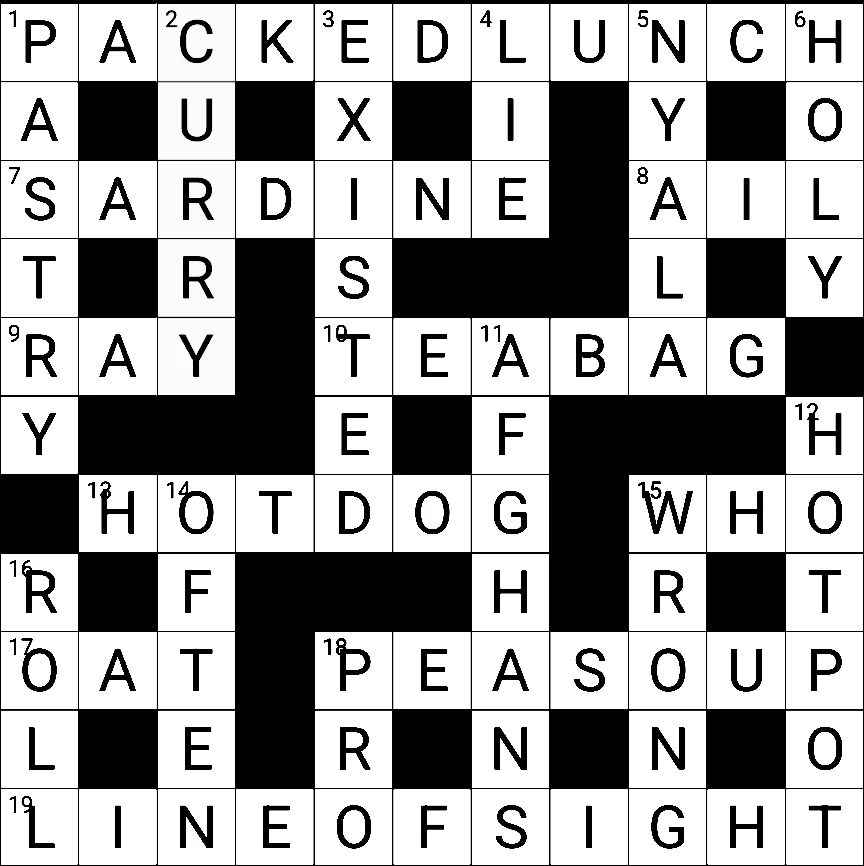
And with colour to show the themed solutions:
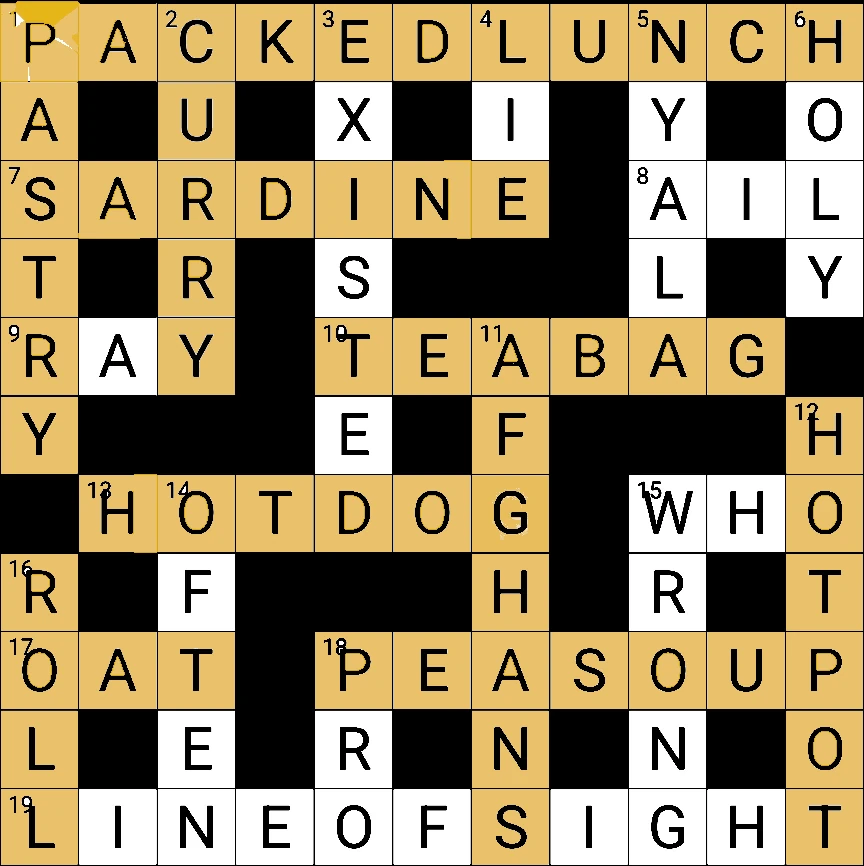
I’ve published this without highlighting the grid with the theme, because it’s not working, again. If I can make the program work, you’ll have pretty colours in a bit.
Ha ha! Colour indeed!
Well I found this the hardest ever because of the Spoonerisms. Never heard of bee tag, or dot hog, the others I managed from letters in crossing words, except Line of sight which I didn’t complete at all despite this being a well known phrase.
Challenging but a lot of fun. Thanks both.
Now I see the point of the colour comment. A food theme. Didn’t realise even though there are lots of food words. Doh!
Good fun in spite of the spoonerisms – not my favourite clue type. At least the other clue types gave good traction and crossers across the grid to help with them. Thanks Shanne, and to Dice.
Mary @2 – that’s often the problem with Spoonerisms, the phrase we’re trying to find is so odd that it’s difficult to spot – there’s no such thing as a “bee tag” or a “dot hog”, but TEA BAG and HOT DOG do exist. I have sung: “Lo, he comes with clouds descending” to get to HOLY, One that Spooner is supposed to have said, in the Wikipedia article, is “tasted two worms” instead of “wasted two terms”. And another was supposed to have been: “You must take the town drain”, not, You must take the down train.
Thanks Shanne. I found this more chewy than usual – not all the Spoonerisms sprang to mind immediately. Nyala was a new antelope for me.
Forgive my ignorance, but what food or drink is ‘AFGHANS’?
Thanks Dice
HumbleTim @6 – Afghans used to be the name of a type of biscuit, commercially produced and sold under that name in New Zealand – I’ve linked to the Wikipedia article on them. In the blurb I do say I’ve eaten them, possibly cooked them or something that the recipe suggested was similar to an Afghan biscuit. I can imagine the taste and mouth-feel.
Shanne@7 – thank you! Apologies for missing that detail in your blog.
Certainly more difficult than usual. I liked the Spoonerisms. SARDINE was my last one as I didn’t recognise ‘cast’ as an anagrind for ages.
Bee Tag is borderline evil. Also, as someone who grew up in Wandsworth, I wasn’t aware I was born within the sound of Bow bells…! Not convinced either…
Thank you, Shanne and Dice.
It was great to have a themed QC.
Never heard of Afghan biscuit. And “Tasted two worms” is so funny. 🙂
I felt a little scared when I saw that we were having spoonerisms and decapitation today, but it turned out to be a lot of fun. Some spoonerisms made me giggle. I worked them out last, having all the crosses, analysing:
aha… Lunch… Lacked… so, Packed Lunch/Lacked Punch…
Tea… Bee… Tea Bag/Bee Tag.
HOLY (lo, he) was the only one I spotted at once.
It wouldn’t be as easy in a full fat cryptic, so thanks for the opportunity to try this clue type.
John @10 – the article I linked to said that CRS is still spoken in the outer London areas. I worked in a factory in Wandsworth 40 odd years ago and there were Cockney speakers on the shopfloor and among the drivers, not just Cockney, Irish, and others, although it wasn’t particularly multicultural then.
I’ve also worked all across the East End – Limehouse, Bow, Roman Road – in the last 10 years and other than the odd person (a grandmother) I worked with there, most were speaking in MLE (Multicultural London English) and were from a range of backgrounds. Even those who had traditional Cockney families were multicultural.
There was far more London Cockney in Harlow, especially 30 odd years ago, Dagenham, Barking and Romford, where a lot of the original Cockney communities were rehoused after the WW2 bombing and slum clearances. And that’s what most research is saying, there is very little Cockney in London, there are pockets where the communities were moved.
I really enjoyed this! The Spoonerisms were great. Scratching my head ref SEA = MAIN?
I think Bee Tag is a possible thing:
#Bee
(Maybe someone is looking for all the articles about bees right now) 🙂
Nicholas Lawson-Williams @14 – sea and main are used interchangeabily in crosswords, I think of the Spanish Main, and poetic language. However, this article looking at this usage is also not happy with how we arrived at this equivalence.