This week’s 11 x 11 crossword from the Guardian intended to teach cryptic crosswords, found here
This puzzle is the 8th Quick Cryptic from Pangakupu. This puzzle has anagrams, hidden word(s) and acrostics with all the letters in the clues, with just deletions where the words and letters need to be found by the solver.
The whole point of these crosswords is support and encouragement of new solvers, so special rules for these crosswords apply – see here – those rules include not posting solving times.
This blog was developed in response to suggestions. We hide the answers and the wordplay descriptions (parsing) too. To find the solution click on “Answer” and to find how the word play works, click on “Parsing” which will reveal the hidden information. You can choose to reveal everything using the “Expand All” button. If you have partially revealed the page, refreshing it will clear that, and allow you to expand all. The definition is in bold and underlined, the indicator is in red.
For additional help click here
There is a summary of the tricks used in the first six months here, if I ever stop for long enough, I’ll build another one, and a Guardian Crossword blog called the ultimate beginner’s guide has tips which may be useful for some solvers.
For abbreviations and clue tips click here
Fifteen Squared uses several abbreviations and jargon tricks, there’s a full list here, of which I’ve used the following in this blog:
- underlining the definition in the clue – this is either at the beginning or end of the clue
- indicators are in red.
- CAPITALS to indicate which bits are part of the answer, e.g. haVE ALtered for the example.
- anagram – letters being used shown in brackets (SENATOR)* for the clue below to give TREASON.
- anagram minus – letters being used are shown as capitals in brackets, with the unused letter in lower case and square brackets – so fluttering (OWLET[s])* becomes TOWEL.
- anagrind – anagram indicator – in the case below it is “arranged”
- soundalike – is indicated by “Wilde” – so in the example, Oscar “Wilde”, the playwright and author, is indicating the soundalike WILD.
- charades – the description below only gives the example of words being added together, but charades can be more complicated, adding abbreviations or single letters to another word. Examples previously used in this series are: Son ridicules loose overgarments (6) S (son) + MOCKS (ridicules), Get rid of dead pine (5) D(dead) + ITCH (pine) – D ITCH, and early on DR (doctor) + IVE (I have) to give DRIVE.
- reversals – the reversal element of a clue is indicated by < – so in the example clue below, VieTNAm <.
- CAD or clue as definition– where the whole clue gives the definition, sometimes called an &lit. These are rare.
- DBE or definition by example – e.g. where a dog might be clued as a setter – often using a question mark, maybe, possibly or e.g. to show that this is an example rather than a definition.
- surface – the meaning from reading the clue – so often cryptic clues use an English that could only be found in a cryptic crossword, but a smooth surface is a clue that has a meaning in English, which can be pointed or misleading.
TODAY’S TRICKS – from the crossword site – because the clues have moved on from the clue descriptions below, I am now adding more to the descriptions hidden above. Clues begin or end with a definition of the answer. The rest is one of these:
- Anagram Anagram of answer and hint that there’s an anagram
‘Senator arranged crime (7)’ gives TREASON (crime) - Hidden word(s) Answer hidden in clue’s words
‘Some haVE ALtered meat (4)’ gives VEAL. - Acrostic First letters of answer
‘Initially Get A Good joke (3)’ gives GAG. - Deletion Remove letters from another word for answer
‘Car trip with no parking, bad thing (3)’ gives SIN
from S[p]IN (car trip) without the P for parking.
| ACROSS | Click on “Answer” to see the solutions | |
| 1 |
Moral system regarding race not new. (5)
|
AnswerETHIC |
Parsingdeletion (not new) from ETH[n]IC (to do with race) with N removed (not new). N for new is found in, say, NT for the New Testament. |
||
| 4 |
Cared about Lebanese tree (5)
|
AnswerCEDAR |
Parsinganagram of (CARED)* with an anagrind of “about” to give this Lebanese tree. “About” is one of the indicators that can be used in many ways – as an anagram indicator, containment indicator and a reversal indicator and ambiguity is something cryptic crossword setters exploit. |
||
| 7 |
Mountain observed in severe storm (7)
|
AnswerEVEREST |
Parsinghidden word(s) (observed in) in sEVERE STorm. “Observed in” is a way of seeing that the letters can be seen in. |
||
| 8 |
Initially cold and nasty vessel (3)
|
AnswerCAN |
Parsingacrostic (initially) of Cold And Nasty. |
||
| 9 |
Leader in table to finish, having displaced second (3)
|
AnswerTOP |
Parsingdeletion (having displaced second)* from [s]TOP (to finish) without the S (having displaced second). S for second is from SI units. |
||
| 11 |
Ragtime dancing? Go elsewhere (7)
|
AnswerMIGRATE |
Parsinganagram of (RAGTIME)* with an anagrind of “dancing” and an anagram has the letters dancing around. |
||
| 13 |
Locum openings for some trainee and new doctors in Norfolk (5-2)
|
AnswerSTAND-IN |
Parsingacrostic (openings for) of Some Trainee And New Doctors In Norfolk, with a nice surface. |
||
| 14 |
Stop contributing to sudden downturn (3)
|
AnswerEND |
Parsinghidden word(s) (contributing to) in suddEN Downturn with another interesting indicator for hidden letters – “contributing to” does say that the words are part of this clue. |
||
| 16 |
Catch ten at sea (3)
|
AnswerNET |
Parsinganagram of (TEN)* with an anagrind of “at sea”. We haven’t had “at sea” for to indicate an anagram for a while, but colloquially it means lost and/or confused, so it works as an anagrind because it’s suggesting confusion. |
||
| 17 |
Adjustment to interim bus stops? (7)
|
AnswerTERMINI |
Parsinganagram of (INTERIM)* with an anagrind of “adjustment to” with a question mark as this is a definition by example – only some bus stops are these, and railway stations could also be. |
||
| 19 |
Concede – acknowledge defeat – maybe it’s tragic at the outset (5)
|
AnswerADMIT |
Parsingacrostic (at the outset) of Acknowledge Defeat Maybe It’s Tragic. |
||
| 20 |
Wipe lance after splintering (5)
|
AnswerCLEAN |
Parsinganagram of (LANCE)* with an anagrind of “after splintering” – and another interesting anagram indicator |
||
|
DOWN
|
||
| 1 |
Big occasion in the Seventies (5)
|
AnswerEVENT |
Parsinghidden word(s) (in the) – sEVENTies – hidden inside the word. |
||
| 2 |
Colour, extensive, but not grand (3)
|
AnswerHUE |
Parsingdeletion (but not grand) – HU[g]E (extensive) with G removed (but not grand) G for grand is UK slang for £1000. |
||
| 3 |
Heavily defeated? Sounded terrified, abandoning son (7)
|
AnswerCREAMED |
Parsingdeletion (abandoning son) from [s]CREAMED (sounded terrified) without the S (abandoning son). S for son is from genealogy. This meaning of heavy defeat goes back to 1929, according to this article, but there’s a question mark saying not the first definition. |
||
| 4 |
Funny act – performer in Lloyd-Webber musical? (3)
|
AnswerCAT |
Parsinganagram of (ACT)* with an anagrind of “funny”, with reference to this Andrew Lloyd Webber musical, and a question mark as it’s a definition by example (DBE), one example of the performer. (And I went to the first London run, sadly no Wayne Sleep for that performance, but everyone else was there). |
||
| 5 |
Decline to ignore King and pass on (7)
|
AnswerDECEASE |
Parsingdeletion (ignore King) from DEC[r]EASE (to decline) with R removed (to ignore King). Here R for King comes from Rex, and the royal monograms. |
||
| 6 |
Stranger carrying compass (5)
|
AnswerRANGE |
Parsinghidden word(s) (carrying) in stRANGEr and here the indicator is indicating that the word “stranger” is hiding (carrying) another word meaning “compass”, and this use is quite poetic. |
||
| 10 |
Ghost? People have always noticed this odd manifestation from earliest points (7)
|
AnswerPHANTOM |
Parsingacrostic (from earliest points) of People Have Always Noticed This Odd Manifestation. |
||
| 12 |
Unbranded contribution from Eugene Richards (7)
|
AnswerGENERIC |
Parsinghidden word(s) (contribution from) in euGENE RIChards – “contribution from” suggesting that the answer can be found within Eugene Richards (an American photographer). |
13 |
Christmas figure’s first appearances in stores after November tenth? Absolutely (5)
|
AnswerSANTA |
Parsingacrostic (first appearances in) of Stores After November Tenth Absolutely – with another fun surface that works as clue as definition (CAD) – except I can find Christmas stuff in store now. |
||
| 15 |
Condescend to plan avoiding South (5)
|
AnswerDEIGN |
Parsingdeletion (avoiding South) from DE[s]IGN (to plan) with S removed (avoiding Sout). |
||
| 17 |
Small child heads for the other table (3)
|
AnswerTOT |
Parsingacrostic (heads for) of The Other Table, with another nice surface suggestion a wilful toddler heading off to something they shouldn’t be going near. |
||
| 18 |
Frozen water: Arctic evidently contains it (3)
|
AnswerICE |
Parsinghidden word(s) (contains it) in arctIC Evidently. |
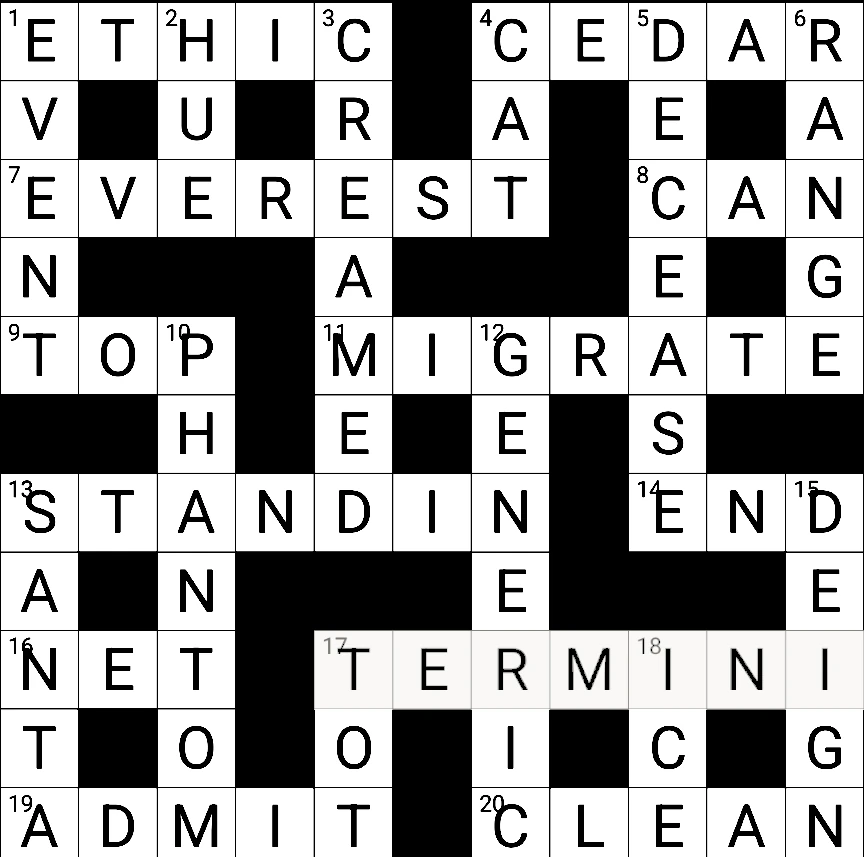
Sorry that this is late – the app is being buggy this morning and for a horrible moment I thought I’d lost this, and as I’m at some random training this morning, I wasn’t going to have time to redo it.
And because of the random training, I won’t necessarily be around to reply to comments until this afternoon. (Necessarily because I may decide the training isn’t relevant, I’m out of sight and can start using my phone.)
Strangely, the clues to 17d and 18d were missing from the print edition, possibly because they were so obvious once the rest of thecrossword was solved!?!?!
I couldn’t parse 9 at all 🙁
Never heard of 3, but guessed it. 5 was LOI and got it eventually.
I find the deletion clues more of a challenge, having to come up with possible words and work them out backwards to see if they fit, whereas the other clues I’m getting the hang of now. Thank you!
Agree deletion clues are one of the harder types – but this was a lovely puzzle with plenty for beginners to enjoy.
LOI DECEASE – king can either be K (as in chess notation) or R (for Rex), so this one took me the longest since I was trying to find words to remove a K from.
Found this much tougher than usual. The deletion clues are certainly the hardest
Managed this OK although had to come here for explanations for 9 and 5. Also the second time in the last two months or so that a clue has been missing from the print version.. 2 this time!
IC @5
I confess that I got fed up with trying to find a word to remove K from and revealed DECEASE!
Could someone do some co-ordination so the tricks we practice on Saturday are used in the Monday cryptic?
As others said, the deletions were a bit tricky, but a lovely puzzle. I assume the “voted” nina in the second column is accidental? Thanks, Pangakupu and shanne
Sandra McNeill @9
One of the midweek puzzles had one or two of the “think of a homophone, then a synonym” clues introduced to the Quick Cryptic last week. They weren’t popular!
I found this very, very cleanly clued. And the surfaces more often than not suggestive.
Thanks for a satisfying composition and for the public service that this blog provides!
Comment #13
Imaginary Cerebellum @5 DECEASE was also my LOI for the exact same reason.
I enjoyed making up my own clues for 17 & 18 🙂
17 tricky to guess as vowels A-E all fit
Cheers S&P
Struggled with the deletions, important to remember that King can be R – like others I took my time with that.
Annoying that 17d and 18d weren’t printed..
I always find the Guardian quick cryptic crossword easier than the quick crossword!
Teenager and I found that relatively straightforward. The deletions are tricky but we’re clearly clued. Only struggle was TERMINI. We knew it was an anagram but it was hard to work out.