This is only the seventh IQ puzzle from Encota since his debut in 2017, the most recent three of which were rather challenging.
Preamble: In order, first letters of single extra words in each clue spell ten words: the first six will help the solver reveal 28 letters spanning the entire grid, which must be converted to suitably sized letters. The first 14 letters of these relate to the seventh word and are an anagram of the full two-word title (to be deduced). The final three words instruct how to reveal which anniversary must be written under the grid. Answers include one abbreviation and some tradenames.
The preamble suggested there were going to be a number of phases to this puzzles: solve the clues, reveal the 28 letters & resize them, figure out the full title, and finally reveal the anniversary. So, make a start on the clues.
Solved a few on Sunday, a few more on Monday – found it hard going. By late Tuesday I had a nearly filled grid. (Making notes for the blog as I go along slows things down. When the weather’s good I go for walks and think about other things.) I couldn’t parse 7d ATOMS without help, and with hindsight I don’t think it’s a very good clue – “spots” = “atoms” isn’t great, and “e.g.” = “as” is a bit iffy – otherwise the clues were excellent, varied, and very inventive. The ten words spelt by initial letters of the extra words in the clues were TITLE LETTERS BECOME DOTS REST BLANKS
/ FOUNDERS / SUM THE DOTS; and on Friday after lunch I settled into the endgame.
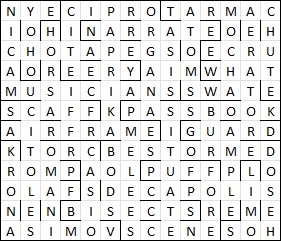
Split the completed grid up into 28 2×3 matrices, à la Braille cells; replaced each of the letters in BRAILLE by a dot and blanked the rest; then decoded the Braille cells to letters resulting in ?EORILL/AND?A?E/MENSAIL/?O?BKTE, which was a bit of a disappointment. It was now clear to me that I needed the full title so that I could replace some more letters in the initial grid with dots … but without the first 14 decoded letters how would I find the full title? Pause for thought.
What’s the simplest change I could make to the top left matrix that would result in the first ? becoming reasonable? I tried N, and hey presto, the first 14 Braille cells now read BERRILL/ANDWA?E. I googled BERRILL and discovered that Roland Berrill and Lancelot Ware founded Mensa on 1 October 1946, which gave me both the anniversary and another letter (W) to replace with a dot thereby revealing WARE. One final letter (D) to replace with a dot & I was done, the last 14 Braille cells now reading MENSAIQ/TRIBUTE.
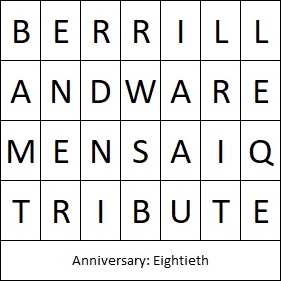
Not quite done, I still needed the full title. Removed the letters in BRAILLE from BERRILL AND WARE and unscrambled the rest to come up with BRAILLE REDRAWN. Counted the dots, and there were indeed eighty.
How does one create such a marvellous puzzle? I’m lost for words. If this isn’t rewarded with an avalanche of points at the end of the year, then Encota can feel hard done by. Thanks a lot; now I need a rest.
| No. | Clue | X | Answer | Wordplay |
| Across | ||||
| 1 | Once nearly [top] in any event (3) | T | NYE | (a)NY E(vent) |
| 3 | [Iain] Banks in Capri for one destroying those found in The Culture? (5) | I | CIPRO | C(apr)I PRO (for) |
| 6 | Take [tons] off tramcar that’s cracked road surface (6) | T | TARMAC | [TRAMCAR ¬ R (take)]* |
| 12 | In pieces, Stu leaves restaurant abroad to tell [lies] (7) | L | NARRATE | [RESTAURANT ¬ [STU]*]* |
| 14 | Unimportant people capturing recording then imbibing hot [espresso] drinks (9, 2 words) | E | CHOTA PEGS | COGS (unimportant people) around TAPE (recording) all around H(ot) |
| 15 | Dull-coloured [leftover] piece of piecrust (4) | L | ECRU | (pi)ECRU(st) |
| 16 | Mysterious [Evangelist] happy after church is abolished (4) | E | EERY | CHEERY (happy) ¬ CH(urch) |
| 17 | Target [toxic] racism ignoring the odds (3) | T | AIM | (r)A(c)I(s)M |
| 18 | Thaw out something [tasty] (4) | T | WHAT | [THAW]* |
| 19 | Queen [Elizabeth], for example, writing about American in charge meeting Scotsman (9) | E | MUSICIANS | MS (writing) around US (American) I/C (in charge) IAN (Scotsman) |
| 21 | [Record] hit in back alleys? (4) | R | SWAT | TAWS< (alleys, marbles) |
| 22 | Second inexpensive restaurant delivering [Sarah] Hamilton’s food (5) | S | SCAFF | S(econd) CAFF (inexpensive restaurant) |
| 24 | Recording of Money featuring passive [bass] at volume (8) | B | PASSBOOK | PASS(ive) BOOK (volume) |
| 27 | Road to the North has [Emmerdale] farmer flying in this? (8) | E | AIRFRAME | A1 (road to the North) [FARMER]* |
| 29 | For the first half, Pep’s defender [crosses] (5) | C | GUARD | GUARD(iola’s) (Pep, foorball manager) |
| 32 | Metal band Tool originally reworking rock [operas], for the most part (4) | O | TORC | [T(ool) ROC(k)]* |
| 35 | Doctor [mounted] more debts once assailed (9) | M | BESTORMED | [MORE DEBTS]* |
| 37 | Frolicking girl cycles [e-bike] around seafront (4) | E | ROMP | PROM (seafront) with letters cycled |
| 38 | Apollo [datacomms] regularly they provided internet connectivity (3) | D | AOL | A(p)O(l)L(o) (internet service provider) |
| 39 | Advertise pick-up following [Ofcom] lines (4) | O | PUFF | PU (pick-up) FF (following lines) |
| 42 | Animated character that’s organised to reduce [telephone] fraud (4) | T | OLAF | double definition {refs. Frozen; European Anti-Fraud Office} |
| 43 | [Star] chamber moved all round biblical area (9) | S | DECAPOLIS | SILO (chamber) PACED (moved) all< |
| 44 | [Real] function divides bits in just this way? (7) | R | BISECTS | SEC (function) divides BITS |
| 45 | Writing primarily about science I’ve [envisaged] machines on Venus (6) | E | ASIMOV | A(bout) S(cience) I(’ve) M(achines) O(n) V(enus) &lit. |
| 46 | [Shakespeare] observed broadcast part of play (5) | S | SCENE | SEEN (observed), homophone |
| 47 | Note introducing String Octet’s [third] harmony (and its composer, in part) (3) | T | SOH | S(tring) O(ctet’s) H(armony) {and ref. (Mendels)SOH(n)} |
| Down | ||||
| 1 | CD-quality sound from the [beat] box carried by Hispanic American (5) | B | NICAM | (Hispa)NIC AM(erican) |
| 2 | You only hear [loudest] one initially in sea chant (4) | L | YO-HO | Y(ou) O(nly) H(ear) O(ne) |
| 3 | Refer to East [Anglian] supporting old Town man (4) | A | CITE | E(ast) after CIT (townsman, archaic sl) |
| 4 | One after Oscar welcoming Young Ones comedian – that’s [never] spicy (7) | N | PAPRIKA | One PAPA (P follows O) around RIK (Young Ones comedian, R.Mayall) |
| 5 | [Knobs] on instrument advanced medieval music parts (6) | K | ORGANA | ORGAN (instrument) A(dvanced) |
| 7 | Spots e.g. round [shiny] jewellery (5) | S | ATOMS | AS (e.g.) around TOM (jewellery, tomfoolery, rhyming slang) |
| 8 | Means of operating [flask] – tea or coffee (5) | F | MOCHA | MO (means of operating) CHA (tea) |
| 9 | [Old] lawncare device sets up place for rubbish? (7) | O | AERATOR | ROT AREA (place for rubbish?) all< |
| 10 | [Unusually] rapid means of descent (5) | U | CHUTE | double definition |
| 11 | Nancy’s [not] outside a WWII glider? (5) | N | HORSA | HORS (outside, Fr) A |
| 13 | Are MI6 [documents] unaltered? (4, 2 words) | D | AS IS | A(re) SIS (MI6) |
| 20 | Necessary and sufficient condition of unlimited [end-to-end] arguments (3) | E | IFF | (t)IFF(s) (arguments) |
| 23 | After the intro, Solstice [recently] seen playing these stringed instruments (7) | R | CITOLES | [(s)OLSTICE]* |
| 25 | Install telco coordination body inside [Swiss] gorge (7) | S | SITUATE | ITU (telco coordination body) in SATE (gorge) |
| 26 | Humming noise [should] irritate, cryptically? (3) | S | BUR | RUB< (irritate, rub the wrong way) |
| 28 | Fights [unfairly] in Middle East – the worst part (6) | U | MÊLÉES | ME (Middle East) LEES (the worst part) |
| 30 | Liberal’s Mark drops in Canadian [moose] symbol (5) | M | AMPLE | MAPLE (Canadian symbol) with M(ark) later |
| 31 | Following [tapas] starter, lady’s fingers sandwiches on Scandinavian bread (5) | T | KRONA | (o)KRA (lady’s fingers) around ON |
| 33 | Shortly returning [Hungarian] national (5) | H | OMANI | IN A MO (shortly) all< |
| 34 | Watch company removing [every] number in gambling establishment (5) | E | CASIO | CASINO (gambling establishment) ¬ N(umber) |
| 35 | Blonde periodically succeeded going after [Dad’s] Army chaps? (4) | D | BODS | B(l)O(n)D(e) S(ucceeded) |
| 36 | Rocky trip traverses [off-road], leaving prostrate dervishes spread out in ceremony (5) | O | DOSEH | [PROSTRATE DERVISHES ¬ [TRIP TRAVERSES]*]* |
| 40 | Driver’s warning [triangle] at the front (4) | T | FORE | double definition |
| 41 | [Suspending] support allowance removing any without motor car (4) | S | LIMO | ALIMONY (support allowance) ¬ ANY |
It was a brilliant construction indeed, and quite a workout. I was stuck for ages after replacing the BRAILLE letters with dots at a loss for how to get going again. Eventually I spotted that the pattern of dots in the central cell of row 2 could only become a Braille letter W (I think this is true) which gave a bit more information to get me to the finish.
One of the best 1Qs of the year in my opinion, and as HolyGhost says it surely should be rewarded with votes at the year’s end.
Many thanks for the challenge Encota and for the blog HolyGhost..
I’m sorry to say that I really disliked this and I’m putting that mildly. Even with the blog I cannot work out entirely what I was meant to do and in all honesty I couldn’t care less about Mensa. It seems to me from my limited understanding that you had to add dots to get the required number, which seems off.
I’m only commenting because I think it’s important that honest feedback is given where others have clearly enjoyed it. One of my least favourite Inqys in recent memory so it won’t be getting my vote at year end
We were – obviously – supposed to do something braille-y, but it really didn’t seem like an attractive prospect and far exceeded my gridfill/endgame time/fuss acceptability ratio. Probably my loss, but it wasn’t my favourite either.
I’m with Bingy.
Several aspects unmentioned in the preamble requiring guesswork and a tedious theme.
Countless more entertaining and rewarding puzzles this year.
I’m afraid I’m another solver who lost interest after solving all the clues. Now that I see the solution, I can admire some aspects – but that’s secondary to my sense of relief! Sorry, Encota – and I expect there will be many people who agree wih Holy Ghost and Sammy.
HG, thanks for the detailed, comprehensive blog.
I’m with the dissenters on this one. No issues with the clues which were good but found the rest very unclear and frustrating. Having found all the extra letters, I divided the grid into 28 blocks and then dutifully copied out the braille alphabet. Applied this and found the very first block didn’t work. I was tempted to give up but continued to dot the 6 letters in braille which gave the same result as in the blog. This had three extra letters, o, n, and d. When adding those, it didn’t work either so then it was time to give up.
The instruction “title letters become dots” was misleading. There was just too much guesswork involved. And what does Mensa have to do with braille?
My least favourite puzzle of the year.
Personally I’m in agreement with HG and Sammy – I was in awe of the construction of the puzzle and though I agree there was a fair bit of work to do in the endgame, the satisfaction I derived from puzzling it out and seeing how it slotted together made it worth it for me.
I do agree the preamble could have been a bit clearer/more detailed though.
Thanks to Encota for the puzzle and to HG for the blog.
Like HolyGhost, this took me most of the week which makes this a good puzzle in my view. Very sneaky though to give us the obvious Braille decoding to do and then we got stuck as we didn’t know all the letters to make dots. I enjoyed having to work it out though, striking lucky after I spotted MENSA.
For me, yogdaws @7 says it all.
I’m another one who filled the grid, got out the Braille cribsheet, and sort of lost interest on realizing the need to guess or deduce the remaining unique letters of the title. HG makes it sound so simple, and now I feel I should have persisted! But the week was full of other distractions. No hard feelings, though. Thanks to Encota and HG.
PS: Nice to see Iain Banks and his creation the Culture remembered.
I really enjoyed this crossword. I was very much helped by having learnt braille so could recognise the letters as they appeared from the dots and to decide which extra title letters were needed to make the dots for the braille letters. Still had to do an online search for Berrill and Ware though, and was stumped by PUFF. It was so pleasing to total all the dots and get 80 for the anniversary.
An amazing puzzle construction; many thanks for the puzzle Encota and to HolyGhost for the blog.
Having seen the full solution, it feels like quite an appropriate recognition of Mensa; a society that appears to be restricted to people with very high IQs, but with a limited idea of how best to apply them. The Braille dots idea was very clever, but like others I thought the need to reverse engineer and guess at the full title was a step too far. It’s obviously absurd for a solver of an IQ crossword to complain about undertaking pointless activity; nevertheless, a really good crossword is satisfying to solve not simply because it is difficult, but because the difficulty feels somehow integral to the puzzle rather than being added in for its own sake. I would gladly have saluted a Braille anniversary, as a celebration of brilliantly-applied ingenuity; using Braille to celebrate Mensa is distinctly anticlimactic. Many thanks to HolyGhost for the blog (and I agree with the reservations about ATOMS); thanks to Encota for making me better informed about Braille.
Another dissenter. Yes, it’s a brilliant construction etc, but it is possibly my least favourite IQ ever. A full grid and well into the endgame before losing interest. As others say, too much guesswork and reverse-engineering required, not helped by an uncharacteristically ambiguous preamble. And personally see little to celebrate in the inane club Isaac Asimo said was full of people ‘brain-proud and aggressive about their IQs’.
Regrettably, I’m with the dissenters here. Not only a preamble that was difficult to understand and a rather tedious endgame, but an awful unch model (2 unches in 4/5 letter entries, 3 in 7-letter and even 4 in 8-letter). Admittedly the thematic material probably demanded such a model but I just found it frustrating.
But thanks to Encota anyway.
We thoroughly enjoyed this puzzle. For us a good Inquisitor needs both an accessible but challenging gridfilll and an endgame that provides interest and not much guesswork. Other than working out which Braille cells needed the extra dots, which wasn’t really and guessing as there were so few possibilities, this was a fun multi-stage exercise for us, which ticked all the boxes.
Thanks to Encota and HolyGhost.
PandJ
I’m possibly between the extremes of views expressed here 😁 I enjoyed the gridfill and I loved that blocks of cells turned into Braille letters which spelt something, that’s a great way of burying a message in a novel way. What I liked less was the need to fill in gaps / reverse-engineer in the endgame, which felt if not quite chicken-and-egg certainly rather trial-and-error, and required parts of my brain that are somewhat underdeveloped!
The twist that it celebrated something other than Braille should really have been expected given that “Braille” was in the title, but I didn’t see Mensa coming until I’d got one of the names. I do kind of see what other commenters mean about the final theme being a bit anticlimactic, although personally I try not too focus to much on whether the actual theme is something I have positive, negative or neutral feelings towards!
But until the last bits of the endgame I thought it was a marvellous puzzle.
Thanks to setter and blogger as ever.