Great fun from Goliath.
A steady solve, filled with witty clueing and brilliant surfaces. Thanks to the setter.
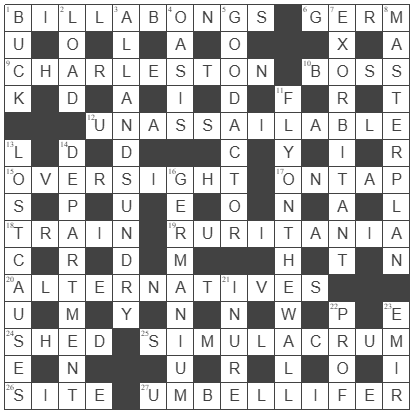
BILL (damage) + (AS (since) acquiring BONG (cannabis delivery kit))
GERM[anium] (first part of, from 16 down’s solution)
CHARLES (His Majesty) + TO + N[ab] (the first)
SOBS* (*uncontrollably)
SAIL (cruise) in (A BUS LANE)* (*out of order)
Double definition
[sto]P AT NO[thing]< (some, <to turn)
Double definition
RU[le] (half of) + [b]RITA[n]NIA (ignoring B[ritai]N (borders))
NATIVES (locals) pursuing ALTER (change)
SHE’D (the girl would)
MUSICAL* (*composition) has RUM (spirit)
“SIGHT” (a sense, “so to speak”)
(L[ive] (beginning to) + LIFE) in UMBER (colour)
Cryptic definition
From the phrase ‘the buck stops here’. From 10 down, the ‘boss’ accepts ultimate responsibility, i.e. that’s where the buck stops. ‘Bucks’ is slang for dollars, from back when buckskins were used as currency apparently.
LO (look) and AD (notice)
(LANDLADY RUNS)* (*amok)
O (love) + AS IS (unchanged)
GO (leave) + (A DOCTOR)* (*cooking)
(EXIT BAR NOT)* (*surprising) – semi &lit
PLASTER MAN (building worker, Spooner’s)
(WHY NO LET)* (*off) during FALL (autumn)
CASSOULETS* (*can be)
DEPART (go) + MEN (guys) + T[rumpet] (intro of)
[ele]M[ent] (its core) in GERANIUM (flower)
IN[j]URE (hurt, after J (Juliet) has gone)
‘Juliet’ is from the NATO alphabet
PRO (supporting) + [Shef]F[ield] (centre of)
[g]E[t] [e]M[broiled] [w]I[th] [t]R[affickers] (second to)
Good fun. My lexicon expanders today were SIMULACRUM & UMBELLIFER.
I agree entirely with Oriel’s introduction – fun from beginning to end.
Splendid anagrams in UNASSAILABLE, LOST CAUSES and, especially, EXORBITANT and I also enjoyed RURITANIA, SIMULACRUM, GOOD ACTOR and FLY ON THE WALL.
‘Australian backwaters’ at the beginning immediately suggested BILLABONGS but it was my last entry, after getting all the crossers. Damage = bill didn’t occur to me (although I’m quite familiar with it and often use it) and I just didn’t know BONG, so I would never have got there from the wordplay.
Goliath is one of the few setters who consistently produce meaningful Spoonerisms, so MASTER PLAN was very satisfying.
Many thanks to Goliath and Oriel.
Short-lived exercise but lots of fun! Required a good knowledge of quirky English idioms.
UNASSAILABLE, SIMULACRUM, LOAD, ALL AND SUNDRY were favourites, along with CASSOULETS for the delightfully silly surface! I agree with Eileen re the Spoonerism comment.
Thanks Goliath and Oriel.
Not sure if I’ve tackled a Goliath crossword before and I really enjoyed it. Will look out for him/her in future.
Favourites: RURITANIA, OVERSIGHT, ALTERNATIVES, MASTER PLAN, GERMANIUM, INURE
Thanks Goliath and Oriel
Your kids and grandkids must all be well behaved Eileen …
grantinfreo@5 – I don’t know about that: I’ve just never come across that word, let alone know what it means. 😉
Fiona @4 – I think you may know Goliath as Philistine in the Guardian.
Thanks to Goliath and Oriel. I echo what others have said: witty and clever cluing made for a fun solve. The very parsable UMBELLIFER is one of those words I think I’ve heard of before, but didn’t know. The only place I have ever seen the word ‘simulacrum ‘ is in the FT crossword. I seem to remember it appearing a couple of times recently, including the plural, simulacra. Doing crosswords makes me appreciate all those years of Latin at school .
Agree with Diane #3 ‘s comment about CASSOULETS
Hmm …
Thanks for the blog , pure class as always and I will just agree with all the lists above . Perhaps SHED could have introduced some Particle Physics .
JKT@7 yes it was Neo , two weeks ago and using musical , the Imp of crossword coincidence strikes again .
Wot no fission ?
Goliath/Philistine does some lovely surfaces: I enjoyed His Majesty nabbing the first dance. Other favourites: FLY ON THE WALL, ALL AND SUNDRY, GOOD ACTOR, LOST CAUSES, the neatly simple BOSS, and RURITANIA (has anyone noted yet that the books set in Ruritania are written by Anthony HOPE? So it’s the kingdom of Hope.)
UMBELLIFERs are the group of plants including cow parsley, hemlock and giant hogweed – also carrots and parsnips.
Thanks Goliath and Oriel. Goliath yet again proving that he does not need to resort to the ghastly device of unsignalled splitting of a clue word to give us an enjoyable crossword.
gladys@10: I noticed the justification for the capital H in 19ac while solving.
I agree with you, Eileen, about the Spoonerism and I liked the clue (and, indeed, the whole crossword), but I thought there was another meaning for the phrase ‘plaster man’ – i.e. someone who blusters, but whose arguments are easily shattered. I can’t find any support for this online, however.
Thanks Goliath and Oriel.
Pelham Barton @11 (and gladys @10) – re 19ac: that’s why it was one of my favourites. 😉
Sourdough @12 – I was intrigued by your comment, which sounded plausible but I could find no support, either. The expression which sprang to my mind was ‘man of straw / straw man’ – Chambers: ‘a sham opponent or argument set up for the sake of disputation’. Not very close – but a reasonable excuse to divert me from my ironing. 😉 )
Umbellifer was new to me.
On the other hand, it was the first time I solved a Spoonerism straight off.
Goliath maintains his high standard. I have little to add to the comments above, but I do want to call out and agree with PB@11.
Thanks Goliath for the excellent crossword, Oriel for the great blog, and everyone else for reflecting my thoughts.
Thanks for looking, Eileen. Perhaps I have coined a neologism! I shall certainly be using it at every opportunity from now on. 🙂
The Prisoner of Zenda is up there with Emma and She in the Crosswordland literary pantheon. Sourdough, are you perhaps conflating a straw man and a plaster saint? Great puzzle as always.
Thanks Goliath, that was fun with OVERSIGHT, ALTERNATIVES, GOOD ACTOR, LOST CAUSES, and INURE among my favourites. I couldn’t parse EMIR; I didn’t think the singular ‘second’ would be used as a multiple letter indicator but I guess that’s OK. In 1a, I thought ‘see’ as a link word between definition and wordplay was a bit careless but not enough to spoil things. Thanks Oriel for the blog.
Petert @18 – I wondered about ‘plaster saint,’ too!
Petert@18. I logged in just now to confess to exactly that – my fevered brain has, I think, created a mash-up of the two phrases. Ah,well…
…and crossed with you, Eileen. Thanks, both, for the responses.
Three caps lock FT setters on the trot (BOBCAT, SLORMGORM, GOLIATH).
Other than that, it’s all been said I think. A quick and enjoyable solve. MASTER PLAN took longer to read than to solve. UMBELLIFER was the only unknown (I fear flora doesn’t stick in my memory).
I liked OASIS, ALL AND SUNDRY and LOST CAUSES. I was introduced to cassoulet when I lived in Toulouse. Marvellous stuff.
Thanks GOLIATH and Oriel.
Martin@23: I am not sure what you are getting at with your first comment. On the pdfs which I print out, setters’ names are always printed in capitals.
Hmm, fair point Pelham. Mostly, but not recent examples of Neo, Peto, Leonidas or Zamorca. It seems the exceptions are the other way around. Despite being here often, I’m more of a Guardian person and they don’t capitalise those on the whole. Forget my previous comment.
Martin@25: sorry to labour this point, but the exceptions you noted are all weekend puzzles. As I remember it, these used not to be shown in all capitals on the pdfs, and the bloggers who deal with the weekend puzzles appear to be keeping to that style. Even these are now shown in all capitals on the pdfs that can be accessed from ft.com. I do not know why the FT always prints setters’ names in capitals, but most (not all) of the weekday bloggers stick to all capitals for the top line of the blog only and switch to normal style in the text of their blogs. If you look on this site’s index pages, you will see the same setters’ names all in capitals on weekdays but not at weekends – Neo is a recent example.
Well I am puzzled.
Does it matter if the names are in capital letters or not?
This was an enjoyable puzzle without obscure words (although I did not know Billabongs but this is my lack of culture) and nice clueing. Thank you Goliath and Oriel.
I have often wondered why the FT writes the names of the setters in capital letters.
Fiona@27: No, it does not matter in worldly terms, but it is of some small interest to some of us. Could not the same be said about crosswords as a whole?
PB@30
I just wondered – thought I might be missing something.
And yes – sadly none of my friends have the slightest interest in cryptic crosswords