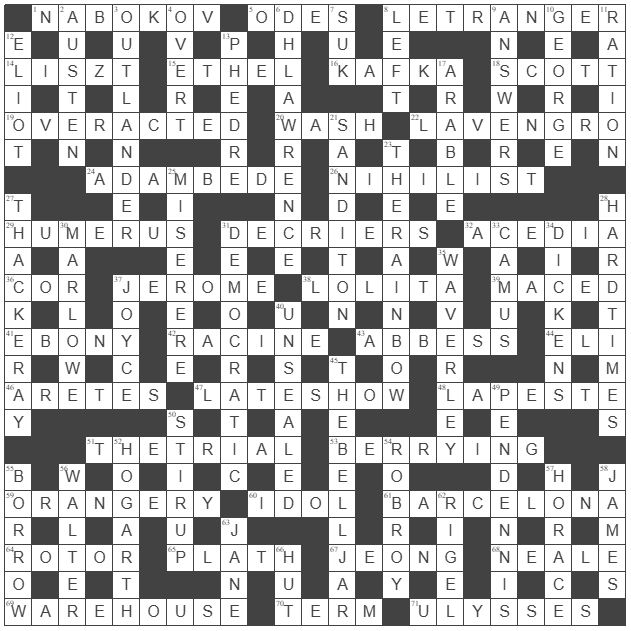
The now traditional Guardian Bank Holiday jumbo puzzle by Maskarade. For some reason, the Guardian chose to print the solution (upside down) immediately below the puzzle in the printed paper. Those solving via the website had to click on a separate link to access the solution. Those who subscribe to the Guardian app did not get offered this puzzle at all! Because there is no prize, and because the solution is immediately available, we have decided to publish this blog early on Monday.
The special instructions read: Sixteen clues consist of anagrams of thematic material, always presented in the right order.
The thematic clues all shared a similar enumeration pattern. Timon and I decided not to try and crack the anagrams before we had some crossing letters, so we decided to solve the normal clues first. These were mainly straightforward, although not all were to be found in the dictionary. The more obscure entries, such as JEONG and NEALE were very fairly clued. The grid, as is usual for these Jumbos, was 23 x 23, but two across clues, at 8 and 69 both had three consecutive unches (unchecked letters), which would not normally be allowed.
The theme was works of literature, followed by the author’s name. Once it became apparent, working out the anagrams was mostly pretty routine, although for some reason Maskarade included three titles in French. In one case, the author’s initials were included (D H Lawrence); in others both first name and surname (e.g. George Eliot), and in others just the surname (e.g. Dickens). The enumerations made all this clear.
As always, congratulations to Maskarade for what must have been a mammoth exercise in grid-filling, not to mention working out all those anagrams!
| ACROSS | ||
| 5/57 | ODES/HORACE |
Red Sea coho (4; 6)
|
| The first thematic clue, though by no means the first that we solved. | ||
| 8/33 | L’ETRANGER/CAMUS |
Clear arguments (9; 5)
|
| One of two works by Albert Camus. | ||
| 14 | LISZT |
Composer‘s catalogue suggested (5)
|
| Sounds like “list”. | ||
| 15 | ETHEL |
Merman provided discreet help, to some extent (5)
|
| Hidden in “discret help”. | ||
| 19 | OVERACTED |
Ted, Vera and co., bemused, piled it on (9)
|
| *(TED VERA CO). | ||
| 20 | WASH |
Stand up in shower (4)
|
| Double definition, just about. Something that stands up to scrutiny might be said to “wash”. | ||
| 22/10/55 | LAVENGRO/GEORGE BORROW |
Begorra! Verger won logo! (8; 6,6)
|
| George Borrow was a 19th century author, best remembered now for this novel and The Romany Rye. | ||
| 24/10/12 | ADAM BEDE/GEORGE ELIOT |
Maid googled ‘bee eater’ (4,4; 6,5)
|
| Another authorial George. | ||
| 26 | NIHILIST |
Heart of philistine turned for one who denies all (8)
|
| *(p)HILISTIN(e). | ||
| 29 | HUMERUS |
Bone’s bad smell certain to return (7)
|
| HUM (bad smell) SURE (rev). | ||
| 31 | DECRIERS |
Reconsider, without working around critics (8)
|
| *REC(on)SIDER. “Around” is the anagram indicator; “without working” tells us to delete ON from the fodder. | ||
| 32 | ACEDIA |
Outstanding helper somehow became sloth (6)
|
| ACE (outstanding), AID (rev) (a helper). This seems to me to be perilously close to an indirect anagram, in that the solver has to think of a word meaning helper and change its format. | ||
| 36 | COR |
My small book or two (3)
|
| COR |
||
| 37 | JEROME |
If thematic, name in full would appear twice pocketing Scandinavian currency (6)
|
| JEROME K(rone) JEROME. in fact the initial K stood for Klapka, the name of an exiled Hungarian general who was staying with the family at the time of his birth. | ||
| 38/1 | LOLITA/NABOKOV |
Look at oval bin (6; 7)
|
| Published in 1955. | ||
| 39 | MACED |
Just over half the mixture is sprayed with tear gas (5)
|
| MACEDoine (a mixture of vegetables or fruit in jelly). | ||
| 41 | EBONY |
Blackwood, bridge player, rather gaunt (5)
|
| E (bridge players are referred to by the points of the compass) BONY (rather gaunt). You have to read the definition as being split into two words. Easley Blackwood was the inventor of a convention used in bridge to enable players to ascertain the number of aces and kings held by their partner. | ||
| 43 | ABBESS |
Nun and mariner live next to ship (6)
|
| AB (Able seaman, sailor) BE (live) SS (ship). | ||
| 44 | ELI |
Priest met Old Vic’s central characters (3)
|
| Central characters of mEt oLd vIc. | ||
| 46 | ARETES |
Fixed time around rugged ridges (6)
|
| SET (fixed) ERA (time) (all rev). | ||
| 47 | LATE SHOW |
Hotel was re-designed for David Letterman’s programme (4,4)
|
| *(HOTEL WAS). | ||
| 48/33 | LA PESTE/CAMUS |
Use place mats (2,5; 5)
|
| The second work by Camus. | ||
| 51/16 | THE TRIAL/KAFKA |
Faith! Take Karl (3,5; 5)
|
| With the help of a few useful crossers, this was our entry into the theme. | ||
| 53 | BERRYING |
Picking fruit and cereal grain and serving gin (8)
|
| BERRY (which can mean cereal grain) *GIN. | ||
| 59 | ORANGERY |
Park officer entered old yard with indoor fruit trees (8)
|
| RANGER (park officer) inside O(ld) Y(ard). | ||
| 60 | IDOL |
Figure one has only half a buck (4)
|
| 1 DOL(lar) (half a buck). | ||
| 61 | BARCELONA |
Olympic venue with watering hole about to entertain billionaire (9)
|
| BAR (watering hole), ELON (Musk) (billionaire) inside CA (about). | ||
| 64 | ROTOR |
It turns round and round and round!(5)
|
| Cryptic definition, referring to the fact that the word is a palindrome. | ||
| 67 | JEONG |
To start with, just explain our new grand Korean concept of an unspoken emotonal bond (5)
|
| Initial letters (“to start with”) of Just Explain Our New Grand. This word isn’t to be found in either Chambers or Collins, but was easily verifiable online and the clue was very fair, giving all the letters unambiguously. | ||
| 68 | NEALE |
Hymnodist from mid-Tyrone – a legend (5)
|
| Hidden in “mid-Tyrone a legend”. Another one we had to check online and sadly not an & lit, as he was born in London. Among other hymns, he is perhaps best known for writing Good King Wenceslas. | ||
| 69 | WAREHOUSE |
Audibly question the location of domestic store (9)
|
| Sounds like “where house?”. | ||
| 70 | TERM |
Some semester mainly (4)
|
| Hidden in “semester mainly”. | ||
| 71/58/37D | ULYSSES/JAMES JOYCE |
July mess ceases – joy! (7; 5,5)
|
| Published in 1922. | ||
| DOWN | ||
| 3 | OUTLANDER |
Unconscious by a heavy blow, one not from around here (9)
|
| OUT (unconscious) LANDER (a heavy blow). | ||
| 4 | OVERT |
Finished last in sprint – that’s clear (5)
|
| OVER (finished) (sprin)T. | ||
| 7 | SUK |
Dvorak’s son-in-law at market place (3)
|
| Double definition: Josef Suk was a composer and violinist who married the daughter of Antonin Dvorak. | ||
| 8 | LEFT |
Went away with the French paper (4)
|
| LE (French for “the”) FT (Financial Times, newspaper). | ||
| 9 | ANSWERS |
One blasphemes without adult responses (7)
|
| AN (one) SWE(a)RS (blasphemes without adult). | ||
| 11 | RATION |
Helping to remove beer from account (6)
|
| RATION(ale) (account). | ||
| 13/42 | PHEDRE/RACINE |
Enriched pear (6; 6)
|
| Another French work. It’s a tragedy in five acts written in verse. | ||
| 17 | ARABLE |
Old discourse, priest forgot to be cultivated (6)
|
| (p) ARABLE (old discourse). Here P is the abbreviation for priest. | ||
| 21/63/2 | SANDITON/JANE AUSTEN |
Don Juan at sea in nets (8; 4,6)
|
| Austen’s last novel, unfinished. | ||
| 23/6 | THE RAINBOW/DH LAWRENCE |
Draw on bent wheel-chair (3,7; 1,1,8)
|
| Published in 1915. | ||
| 25 | MISERERE |
One’s interrupting this compiler twice about Allegri composition (8)
|
| IS (one’s) inside ME (this compiler), RE RE (about, twice). | ||
| 28/34 | HARD TIMES/DICKENS |
Manchester kid’s ID (4,5; 7)
|
| Published in 1854. | ||
| 30 | MARLOWE |
Fictional detective depressed, carried by horse (7)
|
| LOW (depressed) inside (carried by) MARE (horse). The reference is to Philip Marlowe, Raymond Chandler’s private detective. | ||
| 31 | DEMOCRATIC |
About to include Republican leader amid vernacular reference to his opponents (10)
|
| R(epublican) inside CA (about), all inside DEMOTIC (vernacular). | ||
| 35/56/18 | WAVERLEY/WALTER SCOTT |
Travel to West Crawley (8; 6,5)
|
| Walter Scott’s first novel, published in 1814. | ||
| 40 | UNSEALED |
Convertible used lane that’s not yet open (8)
|
| *(USED LANE). I’m not entirely happy with the definition here: “unsealed” can mean “opened” or “not sealed”, so I wonder if Maskarade meant to say “not yet closed”? | ||
| 45/65 | THE BELL JAR/PLATH |
Tell BT – ‘Help rajah’ (3,3,4; 5)
|
| There’s an enumeration error in the clue, which should of course read 3,4,3. The novel was published in 1963. | ||
| 49/27 | PENDENNIS/THACKERAY |
Ninety dark sheep can (9; 9)
|
| Novel published in 1848-50 by Thackeray. | ||
| 50 | STIR UP |
Instigate prison rising (4,2)
|
| A simple charade. | ||
| 52 | HOGARTH |
Engraver, stop on courtyard (7)
|
| HO (command to a horse to stop) GARTH (courtyard). | ||
| 54/56/18 | ROB ROY/WALTER SCOTT |
Rectory blast or two (3,3; 6,5)
|
| Another work by Scott, published in 1817. | ||
| 62 | RIGEL |
State hair product for star (5)
|
| RI (Rhode Island, state) GEL (hair product). | ||
| 66 | HUT |
Regular haunt that’s in the garden (3)
|
| Alternate (regular) letters in HaUnT. |
AID(helper) also bothered me in ACEDIA as being close to an indirect anagram and I think would have been better with a reversal indicator, but its 3 letter shortness is a mitigating factor. My only other bit of a struggle was BERRYING, where I read the clue as “picking fruit and (picking) cereal grain…” and then wondered whether “serving gin” was redundant.
Thank you – really enjoyed this one. I parsed COR as the abbreviation (“small”) of Corinthians (“book or two”). But I do like COR(pus) as well.
Also noticed that 46 (ARETES) was copied clue-and-all from another recent Maskarade. Though I can’t be mad because I didn’t solve it the first time around 😀
The Bel Ljar by Sylvi Aplath.
I’m dubious about 69 – surely a house is a domicile, not a “domestic”. Thanks bridgesong for all the parsings (I was stumped by half a dozen), and Maskarade for the challenge.
Thanks for the blog , a very good idea and lots of very neat clues .
ACEDIA , I agree with Tim@1 , reversal would make it better .
COR , I had the same as Bunc@2 , there are two of them .
ULYSSES /JJ , if only the clue could have used June instead of July .
HARD TIMES/ D , Coketown is partly based on Manchester .
I’m another who thinks the same as bunc @2 re COR. Overall, for me, too much googling required to find authors and / or their works
Um, can’t see the clues to 1 ac or 2 down… or am I missing something?
Lefty Lucy @7: you’re right, they seem to have dropped off along the way. I will try and reinstate them later this morning.
They are both themed Lucy @7. 1 across is part of 38 across and 2 down is part of 21 down
Tim C @9: thanks, I should have realised that was the case!
Lucy #7 – 38/1 and 21/63/2
I found it a little annoying that the clues for numbers like 1, 2 and others weren’t signposted in their proper places to where they could be found as they usually are.
Tim C #9 – apologies, crossed
I found this pretty hard and several were unparsed when I eventually finished. Thanks, bridgesong, it all makes sense now although I, too, thought of Corinthians for 36A.
EleanorK @4: I think we need to read “house” as an adjective, as in “house cat” = domestic cat.
I have now updated the blog to amend the parsing of COR. Thanks to Tim C and others.
Thanks for the parsing of HOGARTH – I couldn’t see it at all. I should have looked up garth, but have never said HO to a horse, or anything else for that matter. I thoroughly enjoyed this, getting the theme after twigging that THE [something] AJAR (the only possible 4-letter word), with P…H to follow, didn’t make a great deal of sense. A good range of authors and books, with only a couple of relative obscurities.
A really enjoyable puzzle with many neat constructions and a well crafted theme. Thanks to M and to Bridgesong for writing informative XL blog in short time.
For once I had the requisite specialist knowledge (a degree in literature) so I thought this would be plain sailing.
Oh dearie me no…
Like others, I often had to work through online lists of authors and/or complete works – and it didn’t help when I learned that there’s also a writer called George Morrow.
I’m by no means a seasoned equestrian but, like Sarah, I’ve never said Ho to a horse. Whoa, yes. Slow down you fool, frequently. Never ho. Oh well…
In fairness, however, it was a Maskarade Bank Hol special, and a certain amount of frustrating obscurity is only to be expected (yes, NEALE, I’m looking at you.)
I’m another “Corinthians” and I, too, only got ARETES because I’d been taught the word in a recent crossword.
On the whole it took far less time than these little beasts usually do, and some of those anagrams were masterly.
Many thanks Maskarade, bridgesong and Timon.
Crossbar@11: that was my main complaint. There’s no earthly reason why those components shouldn’t have been in their proper place with a pointer to the corresponding clue in the time-honoured manner. It meant constantly having to scan through the entire list to find the right one, which became pretty tedious after a while.
I don’t think ACEDIA counts as an indirect anagram, as AID is simply reversed. I’m sure we’ve seen this sort of thing before.
Only one mistake for me: I couldn’t think of JEROME and bunged JORUMS, which seems somehow appropriate.
poc@19: Although “aid” is simply reversed, there is nothing in the clue to indicate a reversal, only an anagram (“somehow”). So regardless of how the solution ends up, you are being asked to think of a word and find an anagram of it. Of the 5 alternative arrangements of “aid”, 1 is a reversal, 2 are cyclings and 2 require only a pair-swap so every variation is simple in some sense. It’s that the clue does not tell you which one. Even the fact that it is three letters requires you to be confident that you have the right synonym for “outstanding”. So, for me, this clue was an indirect anagram. I’ll leave others to discuss if that makes it a bad clue.
A good fun puzzle – Maskarade always provides plenty of gentle entry points and I was pleased to keep way from any reference sources or aids until I was done and could then confirm the few titles I had not met before. Lovely anagrams and a reminder that they can be very tricky when you have no definition to guide the brain.
Thanks Maskarade and bridgesong.
I for one did not think that working out the anagrams was “mostly routine”! Even when the answer turned out to be an author and/or book I had heard of, it was a lot of work to disentangle them.
My last one in was JEROME, which caused me to slap my own forehead once it dropped. I spent far too long trying to do something with KR for krone. Oh well, at least it wasn’t Ford Maddox Ford.
Anyway, a huge thank you to Maskarade for this truly impressive construction.
I rarely bother to try Maskerade’s monsters, but I’m glad I did this weekend. Perhaps it serves me right, then, that I was never going to get ACEDIA, though I did spot the enumeration error on, and it was my way into the fascinating theme. As bridgesong remarks, masterful construction; and a noteworthy blog, so huge thanks to both.
I gave up with the sloth incomplete, brain too tired to see ‘outstanding=ACE. I don’t like the way DIA has been clued, but in fact I had written in the middle letter once I had the D and the A, so complaining that it’s an indirect anagram, as some seem to be, is a little over the top.
I was pleased to have got all the books and authors without looking anything up, which is a first for me in Maskarade’s BH puzzles. Bunged in COR without parsing, and WASH likewise, though neither could be anything else.
I didn’t find the non-themed clues so easy as our blogger, so started work on the anagrams on a sheet of A4 with only about eight or nine entries in the grid, being meticulous about the crossers in order to see the shapes of the words. Eventually Sylvia PLATH’s BELL JAR became apparent and I was off to the races.
GEORGE BORROW’s LAVENGRO reminded me of a Guardian crossword compiler of that name, many years ago, though I was down to my last half dozen by the time I remembered.
Thanks to Maskarade for the workout and Bridgesong for the help with stuff that wasn’t clear to me.
[SH @23
I was just about to mention Lavengro the compiler – as I recall, the first Guardian puzzle I ever attempted was by him. Apparently George Borrow claimed it was Romany for “word master” – how appropriate for a crossword setter!]
I do appreciate these blogs, I really do, so I hesitate a bit to say this. Given the difficulty the Guardian makes to access jumbo specials such as this one, it would be really nice if the blog gave a link to a site where it could be found (at the top, ahead of all the giveaway discussions). I had a hell of a time finding it. There, I said it. Tx!!!
Dr. WhatsOn @25: you make a fair point. Because I always solve from the print edition I never experience the problems faced by those who can only access puzzles online. In fact such a link was provided by duncanshiell when he previewed the appearance of this blog a couple of days ago, but I’ve just tried it and it doesn’t work now! I will try and remember to adopt your suggestion next time I blog a Special.
Yes it did make it a little difficult not having the clues enumerated in their proper place, but really, to do so would have taken up a lot more space on the printed page (and thus printing smaller?), so I’m happy with it as it was.
And there were some obscure works and authors, if by ‘obscure’ I mean that I hadn’t heard of them, but I found the rarefied atmosphere atop the literary mountain quite bracing.
Perfectly pitched for a bank holiday, IMO.
PS, many thanks to Bridgesong for the blog!
Dr W. @25 – The puzzle is available on the Guardian’s crossword page, but you then have to print the pdf version. This is the puzzle
Crispy@28: it’s not necessary to print the PDF. I fact I don’t like doing that because it gives essentially an image of the newspaper version and I find the grid is too small for comfort. I just click on the Print option on the page.
I really enjoyed this Maskarade jumbo, especially having remembered that previous iterations had their solutions on the same page allowing me to take measures to avoid giving myself spoilers (I have emailed Alan Connor to ask the G to please not do this again!) Thanks as ever to TJ for the time and effort.
A quick note on Lavengro the setter: real name Stanley Watt, he made his Guardian debut in the early 1950s and was one of the original 9 setters that were in the stable when pseudonyms were introduced in December 1970. He was the most prolific Guardian setter throughout the ’70s (521 puzzles to Araucaria’s 483) and when he retired in 1984 he had clocked up 678 credited puzzles – joint 6th on the all-time list.
A steady and solve demonstrating this scientist’s lack of knowledge of the literary canon. My first theme answer was ULYSSES, and last was HARD TIMES (made a bit more challenging by both relying on the same crossers). Well done, Maskarade, and thanks to bridgesong.
I remember Lavengro as a Guardian setter but didnt know where the name came from ( did with Bunthorne)
A great grid fill but I ran out of steam -furious at missing the Camus and the dickens as I have read them.Had to dig to find the unfinished JH
Once again a special not being a prize puzzle – this has been the case for a while now (the Xmas puzzle was a letdown too). To be fair I haven’t bothered to send one in for years but it spoils the specialness of it to at least reserve the answers for a week. Lots of looking up lists for me but a good challenge nonetheless. COR – ‘or two’ seems superfluous.
copster @32
Patience (Bunthorne’s bride)? Bunthorne was another setter I remember from my early days. He was either impossible or quite easy, depending on wavelength. I believe he came from Burnley, not far from me.
Surprised there aren’t more of the usual complaints about obscurity, though I did finish this with some recourse to Google. Nho NEALE (despite being a singer), JEONG, SUK or MACEDOINE as a mixture. I like a challenge but felt a few of these were grid-fillers
muffin @34
One of Bob’s memorable clues was EL(3. 6. 10)
I slipped up saying JH instead of J Austen
I thought “or two” in 36 across confirmed Cor as being Corinthians, there being two of them (books, not Corinthians).
Very enjoyable! Thanks!
Ah thanks JohnS #37