The puzzle may be found at https://www.theguardian.com/crosswords/cryptic/30043.
I found this on the gentle side for a Pangakupu (which suits me fine). The grid contains two New Zealand rivers, the Okarito (with a noteable Lagoon) in column 2 and the Tuapeka (associated with a gold rush – is this Pangakupu’s 49th Guardian?) in column 14.
| ACROSS | ||
| 1 | BASS CLARINET |
Bans recitals – where this is played? (4,8)
|
| An anagram (‘played’) of ‘bans recitals’, with an extended definition, although a bass clarinet recital would be something of a rarity. | ||
| 9 | POLKA |
Old President leading America a dance (5)
|
| A charade of POLK (James ‘old President’ of the USA, 1845-1849) plus (‘leading’) A (‘America’). | ||
| 10 | ASTRONAUT |
Australian working with Australian in support for Nasa employee (9)
|
| A charade of A (‘Australian’) plus STRONAT, an envelope (‘in’) of ON (‘working’) plus A (‘Australian’) in STRUT (‘support’). | ||
| 11 | SKID LID |
Went down the Cresta carrying child’s protective headgear? (4,3)
|
| An envelope (‘carrying’) of KID (‘child’) in SLID (‘went down the Cresta’). | ||
| 12 | CHILEAN |
South American or Greek character offering little of profit (7)
|
| A charade of CHI (‘Greek character’) plus LEAN (‘offering little of profit’). | ||
| 13 | SASH WINDOW |
Source of light remains current in plant (4,6)
|
| An envelope (‘in’) of ASH (‘remains’) plus WIND (air ‘current’) in SOW (‘plant’, verb, although I would use SOW to refer to seeds but ‘plant’ to seedlings or larger). Of course, the actual source of light is outside the window, but the window introduced the illumination into a room. | ||
| 15 | RIPE |
Ready to complain after leader’s ousted (4)
|
| A subtraction: [g]RIPE (‘complain’) minus its first letter (‘after leader’s ousted’). | ||
| 18 | TRAY |
Go to bring in a salver (4)
|
| An envelope (‘to bring in’) of ‘a’ in TRY (‘go’). | ||
| 19 | COME-HITHER |
Alluring? Happen to have success with leading man (not love) (4-6)
|
| A charade of COME (‘happen’) plus HIT (‘success’) plus HER[o] (‘leading man’) minus the O (‘not love’). | ||
| 22 | SILVERY |
A lot of mud, intensely gleaming (7)
|
| A charade of SIL[t] (‘mud’) cut short (‘a lot of’); plus VERY (‘intensely’). | ||
| 24 | UNCORKS |
No longer suppresses scorn – UK’s struggling (7)
|
| An anagram (‘struggling’) of ‘scorn UK’. | ||
| 25 | ATROPHIED |
Moved fast after active harbour regressed, becoming degenerate (9)
|
| A charade of A (‘active’) plus TROP, a reversal (‘regressed’) of PORT (‘harbour’) plus HIED (‘moved fast’). | ||
| 26 | NATAL |
Describing birth name in any way? Not entirely (5)
|
| A charade of N (‘name’) plus AT AL[l] (or ATALL; ‘in any way’) cut short (‘not entirely’). | ||
| 27 | OCKHAM’S RAZOR |
Wild shamrock Portuguese islands twice cut down, reducing unnecessary quantities (7,5)
|
| A charade of OCKHAMSR, an anagram (‘wild’) of ‘shamrock’; plus AZOR[es] (‘Portugese islands’) minus the last two letters (‘trice cut down’). | ||
| DOWN | ||
| 1 | BALTIC SEA |
Basalt cracked with ice in chilly water (6,3)
|
| An anagram (‘cracked’) of ‘basalt’ plus ‘ice’. | ||
| 2 | SHALLOWS |
Mum permits paddling here? (8)
|
| A charade of SH (‘mum’) plus ALLOWS (‘permits’) – and why not acknowledge an exrended definition. | ||
| 3 | CHARD |
Vegetable, cold, resistant to the bite (5)
|
| A charade of C (‘cold’) plus HARD (‘resistant to the bite’). | ||
| 4 | ARTICHOKE |
Vegetable skill – I fail at a crucial moment (9)
|
| A charae of ART (‘skill’) plus I CHOKE (‘I fail at a crucial moment’). | ||
| 5 | ICONIC |
Admired pair about to study carbon (6)
|
| A charade of ICONI, an envelope (‘about’) of CON (‘study’) in II (Roman numeral 2, ‘pair’); plus C (chemical symbol, ‘carbon’). | ||
| 6 | ERASE |
Delete Times article finally (5)
|
| A charade of ERAS (‘times’) plus E (‘articlE finally’). | ||
| 7 | OPUSES |
Applications supporting section of stage work (6)
|
| A charade of OP (theatrical; an initialism of opposite prompt, stage right ‘section of stage’) plus USES (‘applications’). ‘Work’ as body of work justifies the plural answer. | ||
| 8 | AT ONCE |
Immediately agreeing to bring in Conservative (2,4)
|
| An envelope (‘to bring in’) of C (‘Conservative’) in AT ONE (‘agreeing’). | ||
| 14 | NEODYMIUM |
Metal? You mined rocks, gaining mass (9)
|
| An anagram (‘rocks’) of ‘you mined’ plus M (‘mass’). | ||
| 16 | INHERITOR |
I note that woman with sex-appeal and gold – recipient of legacy? (9)
|
| A charade of ‘I’ plus N (‘note’) plus HER (‘that woman’) plus IT (‘sex-appeal’) plus OR (‘gold’). | ||
| 17 | PINCE-NEZ |
They help one view fix over Church elevating Eastern philosophy (5-3)
|
| A charade of PIN (‘fix’) plus CE (‘Church’) plus NEZ, a reversal (‘elevating’ in a down light) of ZEN (‘Eastern philosophy’). | ||
| 18 | TUSCAN |
Parts swapped in Latin song from part of Italy (6)
|
| CANTUS (‘Latin song’) with ‘parts’ CAN and TUS ‘swapped’. | ||
| 20 | RESULT |
Concerned with Muslim leader rejecting an outcome (6)
|
| A charade of RE (‘concerned with’) plus SULT[an] (‘Muslim leader’) minus AN (‘rejecting an’). | ||
| 21 | TEMPEH |
Beautiful spot to get hot Japanese food (6)
|
| A charade of TEMPE (a gorge in Greece, noted for its rugged beauty, ‘beautiful spot’. My memory of it is in the morning following a violent thunderstorm overnight, with the cliffs shrouded in cloud and water gushing out of every low spot) plus H (‘hot’). Tempeh is primarily an Indonesian food – Javanese rather than Japanese. | ||
| 23 | LYRIC |
Only rich seen around this theatre? (5)
|
| A hidden answer (‘seen around this’) in ‘onLY RICh’, for the name of various theatres, including one in London’s West End. | ||
| 24 | UNDER |
No place to steal from subordinate (5)
|
| A subtraction: [pl]UNDER (‘steal’) minus PL (‘no place’). |
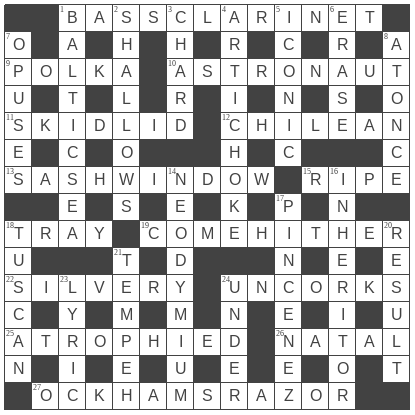
Maybe the setter confused TEMPEH with tempura?.. I didn’t get it or COME-HITHER. But anyway, it was an enjoyable puzzle and I can’t wait to learn how the gold rush places are connected with 49. Thanks P and P!
Layman @1 Since you can’t wait:
In a cavern, in a canyon
Excavating for a mine
Dwelt a miner,49-er,
And his daughter, Clementine;/em>
1849 was the date of the great California Gold Rush
Had to be Ockham’s Razor, though I’ve almost always seen it as Occam’s.
I didn’t understand the ‘beautiful place’ reference either. Google just threw up a city in Arizona, but the Greek name must have come first. Another gap in my GK. Liked ATROPHIED for the regressed harbour and OCKHAMS RAZOR for the anagram and geographic reference. Did find this puzzle difficult to break into on my first pass through the across clues with COME-HITHER being my first one in, but as usual the down clues provided illumination. The president in POLKA didn’t immediately spring to mind. Actually managed to spot the ninas, but didn’t understand the signficance. Thanks to PeterO and Pangakupu.
Thanks Pangakupu and PeterO
Baffled by TEMPEH. I knew it as a food, though not Japanese, but TEMPE was completely unknown.
COME HITHER is an example of a type of clue I dislike. No chance of building it up from its parts, I think – did anyone do so?
Apart from those, very entertaining.
Balfour@2: thanks!!
It’s a double phi day and this puzzle here – to me at least – was one of his toughest. I rarely struggle with Pangakupu/Phi but this was very hard and I failed to fully parse a few which is unheard of normally with P’s precise immaculate cluing. Onto indy
Beaten at the end by OPUSES – nho OP = opposite prompt = section of stage – and by TEMPEH – nho either the beautiful spot nor the foodstuff, whether Indonesian or Japanese. And I’m another who’s familiar with OCCAM rather than OCKHAM though I was able to work that one out. I liked BALTIC SEA.
Thanks both
Key places in the NZ gold rush(es) it is.
As for Tempe, here’s Chambers definition:
The valley of the Peneus in Thessaly, praised by the ancient poets for its unsurpassed beauty
Hence, any place of choice beauty
(The Arizonan version, where the beauty is rather starker, is twinned with the town of Upper Hutt, just up the road from me.)
And Chambers on tempeh:
A high-protein food prepared by incubating soya beans with a fungus to bring about fermentation, made esp in Japan and Indonesia.
Tempe became a shorthand for any beautiful place, especially a valley, and hence for an ideal rural place, an earthly Eden (like Arcadia), as in the 1632 court masque Tempe Restored, in which (of course) the queen Henrietta Maria restores harmony to the valley through her ‘Divine Beauty’.
Not as tough as I usually find this setter although having never seen that spelling of Occam’s razor it did cause a brief pause.
Ticks for ICONIC and SHALLOWS.
Thanks PeterO and Pangakupu
Ockham vs Occam: William was from Ockham (probably) which is a small village in Surrey very near Wisley RHS gardens, so I pass by it often. I fear it is being overwhelmed by a new development at the moment. I think the “Occam” spelling comes from Latinising his name as he would have published in Latin.
I was grumpy about “tempeh” but Pangakupu justifies the “tempe” part which simply shows my ignorance, not an unfairness from the setter. However, I would dispute calling it a Japanese food in spite of Chambers – just because something is popular in a place does not make it of that place. Otherwise we could call lasagne and curry English foods as they are common options in restaurants and pubs here.
Nevertheless, good fun – thank you P. and PeterO
Glad to see I wasn’t the only one held up/confused by tempeh. I’m also happy that the nina is interpretable by mere mortals, and that I have a chance of remembering where we are in the sequence when the next one comes around because this one is memorable!
I’m another that was stumped by TEMPEH. I suspect a typo in the clue – Javanese, not Japanese. Otherwise lots of fun, and I’m glad I’ve been introduced to SKID LID.
Ho hum. Not my favourite though it was easy with a couple of tough clues. Had to read the blog for some parsings. Couldn’t get TEMPEH as nho Tempe or tempeh. Too obscure and no way in from the clue. Also nho SKID LID but obvious from the clue nor cantus, but again easy to guess TUSCAN. I have mostly seen Occam but Ockham is the modern spelling of the place so OK. And what a horrid word opuses is, but the Latin plural is opera so had to be.
Thanks P&P
I wasn’t sure about OCKHAM’S RAZOR but it seemed like the simplest solution 🙂
Maybe the spellchecker got involved with TEMPEH or perhaps Japanese offered more misdirection?
Cheers P&P
I could not parse 10ac and for 7d I did not know why op = section of stage. I see now that I did not parse 24d properly, simply assuming not was sort of a cd.
New for me: neodymium, the Cresta (for 11ac), skid lid, spelling of Ockham’s razor (rather than Occam’s).
21d I agree with PeterO that tempeh is Indonesian food, not Japanese. I also did not know why is Tempe considered a beautiful spot, assuming he meant Tempe, Arizona! All in all, this clue was rather weak, both from the perspective of tempeh which is not a Japanese food (at least no more than sushi is English food) and “beautiful spot” being too vague. By the way, having lived in Indonesia for many years, I love to eat tempeh 🙂
Hello Pangakupu@90 – Chambers can make mistakes, or be vague, as proven here even though tempeh is produced in small quantities in Japan. Tempeh is also made in England but that does not make it English food. Tofu is more common to Japanese cuisine than tempeh. Even the Japanese import tempeh from Indonesia.
I agree with comments by Jack of Few Trades@12.
When even googling ‘Japanese foods list’ doesn’t help, it’s time to give up. Editor – you had one job…!
A bit of a learning curve today. The BASS CLARINET and the OP “section of stage” were news to me, as was the “famously beautiful” TEMPE. NEODYMIUM, as the most probable-looking result of its anagram, turned out to be right. I also had trouble identifying the STRUT in ASTRONAUT and the SILT in SILVERY, both bunged in from definition.
Today’s favourite definitely SHALLOWS – I could do with some to paddle in right now: the temperature indoors is 28.6 and like a troll, my brain gets stupider as the mercury rises.
Thanks Pangakupu and PeterO.
Fun to be reminded of SKID LID and I guessed COME HITHER. Completed more than usual of a Pangakupu, but can’t be bothered with the hidden extras.
Opuses last in, d’oh. Did an Oz Opera season as backstage casual, circa ’70, remember prompt side but not its op. Fun puzzle, ta PnP.
[Ditto my sis in N8. 30° at 8am, Gladys @19, “obscene”, she says]
I commented on the possible typo in the G thread last night (too hot to sleep, and I was also watching the Javan v Sweden game). I did spot the Ninas as places, (TUAPEKA, according to the dictionary also means deceitful) but I couldn’t relate it to 49. I enjoyed BALTIC SEA, having dipped my toes in Jurmala, Latvia last month and it was quite pleasant rather than chilly. Also likes for BASS CLARINET, SKID LID, SILVERY, OCKHAMS RAZOR and PINCE-NEZ.
Ta Pangakupu & PeterO.
A note on the Tempeh clue – in my mind, TEMPE is always associated with Keat’s Ode on a Grecian Urn. In the opening stanza when he is considering the figures on the vase.
“What leaf-fring’d legend haunts about thy shape / Of deities or mortals, or of both, / In Tempe or the dales of Arcady?”
In defence of Pangakupu, I think this is an accessible reference, at least as much as a Milton reference or Shakespeare.
Happy to confirm that this is indeed Pangakupu’s 49th Daily Cryptic for the Guardian.
My rather old (1990 ed) copy of Chambers doesn’t list TEMPEH at all, so gives no clue to it’s nationality. It does, however, list ‘Tempe’ as ‘the valley of the Peneus in Thessaly, praised by classical poets for it’s beauty; hence any place of similar beauty’.
AlanC@22 – I laughed at your reference to the the Javan v Sweden game 😉
No fault of the setter, but I hate it when I complete everything fairly easily and then spend ages staring at -i-e, failing to think of a word for complain.
Never heard of the TEMPE gorge, though years ago I walked down the magnificent Samarian Gorge on Crete. Hardly saw a person all day – apparently, it’s not like that any more.
Couldn’t parse OPUSES, or POLKA as I hadn’t bothered to find Mr Polk in a list of US Presidents. Maybe the continuing heat here, but found this a bit of a curate’s egg. Did like the BASS CLARINET and BALTIC SEA, however…
A curate’s egg indeed!
Easier for me than the usual Pangakupu. Is Roz’s theory proved correct? Maybe at her level. I seem to remember last week being tougher.
My lack of specialist TEMPEH knowledge was help not hindrance. I lookup TEMPE in Chambers and there it was.
Strange that Occam’s name hasn’t had his razor applied.
I liked SKID LID, SASH WINDOW and NEODYMIUM.
Thanks P&P
muffin @5: luckily, I was able to build COME HITHER from its parts, or else I would not have solved it from the definition.
Could not see OPUSES for the life of me so a dnf here. I had thought 18d was very neat but then realised from the blog that CANTOS was wrong. And me a classicist in my school days! So more befuddlement today.
LOI was OPUSES, which grates on the ear. OPERA is surely the right plural, but Chambers allows the alternative. I had to look up Opposite Prompt (the ‘prompt corner’ is traditionally stage left, so stage right is OP). And it also says TEMPEH can be Japanese, which was helpful even if wrong, as I didn’t know the classical reference but did remember the food.
I didn’t like COME=’happen’, but it couldn’t be anything else.
With those exceptions, I thought this markedly easier than usual for this setter, with quite a few write-ins.
Mostly fun, as always with this setter, but with a couple of niggles.
TEMPEH I think we simply have to ascribe to a typo that should have read “Javanese”, otherwise it is an error that eluded both the setter and the editor. I am also among those never to have heard of TEMPE, but one person’s GK is another’s obscurity.
I have never heard of “opposite prompt” and would aver that is genuinely obscure, and there are a great many other ways to clue OP.
And I have never heard of SKID LID, but I assume that is just me and that it has wide currency in Britain. Conversely, I was familiar with both spellings of Occam/Ockham.
poc @33. I don’t have any problem with COME = happen, and don’t really grasp what yours may be. See, for example, Albany in King Lear:
If that the heavens do not their visible spirits
Send quickly down to tame these vile offences,
It will come,
Humanity must perforce prey on itself,
Like monsters of the deep.
I also failed on OPUSES, having never heard of the theatrical OP. I may have been able to guess the solution anyway if the clue had said ‘works’ instead of ‘work’, though the singular is perfectly valid.
Otherwise very enjoyable. Thanks both.
An incidental connection of METAL, the music, with neodymium, is that neodymium is used in some modern loudspeakers to make the cabinets less HEAVY.
OCKHAM’S RAZOR. Is “quantities” appropriate in the definition part of the clue? It made me think at first that we were after someone else’s razor.
How are we supposed to know TEMPE?
Ive eaten more Japanese food that I can remember. Tempeh is certainly not on any Japanese restaurant menu I’ve been to.
Never heard of OCKHAM’S RAZOR
Every Japanese word ends in either a vowel or an N, and when transliterated into the Latin alphabet (romaji), that rule is observed. So I was a bit taken aback when I was required to find a Japanese food ending in H. Fortunately, I’ve eaten TEMPEH, so I plunked it in. For the record, Tempe, AZ, is far from beautiful.
Very enjoyable in that “just do what the clue asks” way, where perseverance brought eventual success most of the time! I failed on two clues, which I still think are somewhat obscure: OPUSES and TEMPEH.
Why is there a question mark in the clue for the metal (NEODYMIUM)?
All seemed very straightforward until the SW corner. Despite once studying Keats, TEMPE was (many years later) unknown to me. Meanwhile on a less cultural note, SKID LID I have definitely never heard of, but got it from the wordplay and crossers, so that’s fair enough. Had never seen OCCAM’S RAZOR spelt that way, and my lack of Latin meant I had to come here to understand the parsing of TUSCAN but again, both of these were clear from the wordplay.
It’s a Friday, which means it’s the day (beyond the prize), setters get to go all out showing their skill and knowledge and making me feel dumb whilst learning.
Loads I got but couldn’t parse – so thanks PeterO for helping me understand Tempeh.
My favourite will be the only one I had to cheat on and ask for a reveal – Tuscan.
Makes complete sense and though I’m not much into Latin, Cantus is a word I know from choirboy days, so should have got.
Extra points for atrophied, as I didn’t know the word “hied” until now.
As an aside, I got Pince-Nez from a joke Phil Jupiter made about Stephen Fry’s version of beer goggles on QI once!
“He doesn’t have beer googles! He has Madeira Pince-nez!”
Managed to figure out several new words and terms, including OP for stage right in 7d OPUSES (loi), even though I’ve been involved in a lot of theatre. Favourites 1a BASS CLARINET (anagram, unusual construction), 13a SASH WINDOW (“plant” verb), 2d SHALLOWS (extended definition)
Many thanks Pangakupu and PeterO
bodycheetah@16 “simplest solution”! Well done! 🙂
OPUSES? No, no, no… It’s like a linguistic gearbox making awful noises and shedding teeth in all directions. It may be in Chambers but it’s still horrible.
That aside (Mrs Lincoln), all most enjoyable, though I was puzzled over TEMPEH.
BASS CLARINET was a very neat anagram, and I enjoyed the assemblages of ASTRONAUT and SASH WINDOW.
Thanks Pangakupu for the challenge , and PeterO for the explanations of much that I was hazy about.
Went down the Cresta?
Can someone explain?
Most enjoyable – particularly liked OKHAMS RAZOR, COME HITHER and ATROPHIED
Many thanks both and all
Jim @47
The Cresta Run is an ice track in St Moritz, Switzerland where many sledding races have been held.
Jim @47
The Cresta Run is a toboggan track near St. Moritz in Switzerland. You go down it by SLIDing!
Fun again.
nho SKID LID but put it together, more or less.
I can usually spot the ninas, knowing not a word of Maori, by seeing which of the ninas gives something pronounceable. Row 6 ESEKPN, for example, hadn’t a hope.
MN@7 Double phi?
An earlier puzzle (years ago) defined SALVER as “used to convey trifles to the eminent.” Are they always silver?
Thanks, Pangakapu and PeterO.
Thanks for the blog , pretty neat overall although OPUSES a very ugly word and could have been spasms . NEODYNIUM the wonder element for magnetic alloys .
Clowns to the left of me
Jokers to the right
Here I am …….. every day , week , month , year ….
The setter@9 has explained why he used the word Japanese. Until then, I did suspect a Graun moment or incorrect editing.
I’ve never seen OCCAM spelt like that, I know of Tempe but not TEMPEH, and OPUSES is just wrong. My Concise OED even has ‘magnum opuses’!
Dave F @54
“Japanese” isn’t essential to the construction of the clue. He would have caused a lot less argument if he had used “Javanese”, or even just “Indonesian”!
Maybe not many classical bass clarinet recitals but lots by the great Eric Dolphy, particularly a duet version of ¨Come Sunday¨ with Richard Davis on double bass and a solo version of ¨God bless the child¨.
TEMPE(h) has turned up in Azed a few times and the Guardian now and then , usually the same type of definition . TEMPEH is rarer but not extinct .
It was definitely William of Ockham but Occam is more common for his razor .
Took a few visits to get through. The top half fell into place relatively easily but the bottom half was much more challenging. Like others I was OCCAM rather than OCKHAM and this threw me for a while. But all in all lots to enjoy. Thanks Pangakupu, finishing your grid made it a clean, but challenging, sweep for this week’s weekday Cryptics, and thanks Andrew for the blog it cleared up some wordplay queries I had.
David Mansell @57 Lots of bass clarinet from Harry Carney with Duke, who wrote for it quite a lot, but not I think in Come Sunday’s original setting Black, Brown and Beige.
muffin @56: “He would have caused a lot less argument if he had used “Javanese”, or even just “Indonesian”!” To be fair, that seems ti me to me to be a case of victim-blaming. For long after Panga had cited Chambers in justification @9, the argumetatives continued to swarm around claiming that it was a setter stupidity, or a typo, or a lamentable failure of editorial oversight, when clearly it was none of the three.
Never heard of TEMPEH and have only the vaguest of memories of Tempe; so that was my last one in.
Couldn’t parse UNDER but now I understand it I like it.
Balfour @61
I don’t understand your comment. It seems incontrovertible that TEMPEH is a Javanese dish. Chambers has either given a misleading example, or actually made a mistake, which Panga has used as justification. I suppose it is – “it’s in Chambers” is an irritating mantra – but why not use Javanese rather than Japanese? It makes no difference at all to the parsing of the clue.
Whilst TEMPEH was my Wasim Akram (stubborn tailender and LOI) clue having checked the etymology and satisfied myself it wasn’t Japanese I still thought this was a great crossword and loved learning of the 49 composition here. BASS CLARINETs deserve more than their ‘entry of the villain’ soundtrack reputation but please not a whole recital. Thank you both.
An exception to mrpenney’s rule (@40) is the Noh theater, presumably because No theater would be confusing. Still this was a dnf for me because no Japanese food with those crossing letters seemed possible.
The Guardian has now corrected Japanese to Javanese.
Tempeh is an improvement on tofu, which is perhaps not terribly high praise.
So the Guardian has admitted the error. So much for Panga’s justification! It just seems that some one was careless.
Can someone please explain how gold rushes come into it?
muffin@5: like AlanC@31 I built up COME HITHER, but from the back. Thought it would end in HER(o), then got HIT= success, then it had to be COME.
Saw that SPASMS would fit at 7d, as did Roz@53. Found on looking it up in Chambers that part of one definition of SPASM is ” a section of a performance”, which fits with some of the clue but of course doesn’t parse.
Tony @67
As pointed out by Balfour @2, 1849 is the date of the great Californian gold rush. Pangakupu has set himself the task of incorporating some Maori reference to the ordinal number of his Guardian cryptics – in this case his 49th – into the appropriate grid. The thought of doing that while also coming up with a satisfying set of clues is beyond me.
A technical fail for me, as I had given up with TEMPEH unparsed and not written in, and no idea about 22a. But a quick read of PeterO’s prelude told me that column 2 had Okarito reading down, so I was able to “solve” SILVERY and bung and shrug the Japanese foodstuff in. Sorry, Javanese. 😜
This was a very wavelength- or GK-dependent solve. I dredged “opposite prompt” from a dark and gloomy recess, but it took me several more rummaging sessions to find the ‘Metal?’, having spotted a couple of convincing imposters that didn’t align with subsequent crossers.
I was pleased with myself for working out the part-swapping song, and remembering that “away to the maypole hie” meant to run there, rather than that the pole was high!
Thanks to Pangakupu for an entertaining and challenging puzzle, and to PeterO for the superb explications, as ever.
PeterO – interestingly, I have subsequently spotted this comment from Pangakupu on the G’s own comments thread, which shows that he too was thinking of ‘My Darling Clementine’, which I quoted @2:
“For those counting, puzzle 49. NZ has caverns and canyons as well…’
i note with a sigh that there’s a correction on the page now, replacing “Japanese” with “Javanese”, which i’ll admit i thought must have been the mistake, before i reached for my Chambers.
…and the defs. are right there, with TEMPE being any place of natural beauty and TEMPEH listing Japan first as a producer.
sorry, Panga, but it seems pretty obvious to me that TEMPEH was a grid fill, and not a word you knew before you looked it up.
Tempe is too obscure to be a reasonable reference, but Panga couldn’t have known this from Chambers def if they didn’t bother to look further, in which case they might have gone with different wordplay.
Just because Japan produces tempeh, doesn’t mean it’s Japanese food. Curry isn’t British food after all. Panga would have used “Indonesian”, not “Japanese” if they’d bothered to look further.
So not a typo, just lazy setting, imo
Ozof@72. Did you read all the other comments about this clue? All of your points have already been made. I’m not comfortable with the way you and several others have been having a go at our setter in what has now become a very unpleasant fashion.
Pangakupu is one of the few setters who join in the discussions about their puzzles. Did you think of that before you posted, or did you just want to join in with giving a good kicking to someone who is doing their best to provide us with an entertainment.
I was entertained, you just seem to be spoiling for a fight.
ozof@72, why do you suppose that our setter hadn’t heard of TEMPEH? I’ve heard of it – unfortunately even eaten it once I think – but didn’t have the foggiest which specific cuisine it comes from. Why can’t that also have been the case for our setter?
Wouldn’t you think that the completely normal thing to do would be to look it up in Chambers when researching how to clue it, and if for some reason that infallable reference says that lasagne is an English and Italian dish, well you’d just take that at face value, wouldn’t you? Especially if you’d been to England and seen it in restaurants.
So I don’t think any cardinal sin has been committed, and I’m rather inclined to agree with sheffield hatter.
As for the puzzle, my experience matched several others’ here. Seemed Monday-ish in many places but then with a bit of unexpected spice thrown in. Fortunately I could get those bits from the checkers, including TEMPEH indeed but also OPUSES (yuk), POLKA, TUSCAN (the latin seemed likely enough), NEODYNIUM and PINCE-NEZ. The stumble I had with the latter is that HITCH parses perfectly too and matched the checkers.
Fave was probably ATROPHIED. And Petert@27’s experience matched mine completely. – i – e indeed.
Thanks both. Looking forward to #50
muffin#71 yesterday
At 77 I’ve identified the beer you were thinking of as “Starlight”, one of Watney’s worst with an ABV of 2.9% which qualified it as like making love in a canoe.
@73 i hadn’t read the other comments. if you really think a single criticism is “spoiling for a fight”, then you’re part of a serious problem with today’s hair-trigger sensibilities. i don’t mind paul’s puzzles; he’s a decent enough setter, but i stand by my conviction. it was a very poor clue, subsequently mishandled.
@74 i didn’t suggest paul hadn’t heard of tempeh. i’ve heard of tempeh, but I didn’t know it, so i would refer to a definition or two to learn more about it before daring to define it in a GCCW clue. pay attention.
NEODYMIUM is nice trap for those with the N-M issue, as the comments here show handsomely, I think.
I failed on OPUSES even though I guessed the USES part, and used to have regular connections with stage work. We simply referred to “stage L” or “stage R” along with the same for “audience” There were a few rapid eyes left-to-right with this puzzle, but so there should be, perhaps.
We need a mnemonic for the spelling of NEODYMIUM .
Ozof@77. Unlike you I had read all of the comments before commenting myself. This was therefore not a hair-trigger moment but a final straw.
ozof@77: don’t you think it would be polite to read other comments before posting? I usually do the puzzle in the evening and know that I will come late to this conversation. If I find that I have nothing new to say I don’t say it.
Thank you Pangakupu and Petero.
Hector#81
Well said.
ozof@72&77 comes across as one who derives pleasure from picking fights. First he picks a fight with the setter, then he picks a fight with sh@73 and he insults the setter by getting his name wrong, perhaps hoping to generate another fight.
There are many like this in the world, and perhaps we should not begrudge them their source of fun. We all find our pleasure in different ways – that is part of the mosaic of life. (See Monty Python, the Argument sketch.)
I do like academic arguments , must admit I spend too much time baiting the Maths faculty over foundational issues .
I do think I have behaved well in the Guardian blog today for the Prize , even if I say so myself .
Cellomaniac#84: Shut yer festerin gob ya tit.
Roz @85. Do you mean that you don’t think that a crossword in a national newspaper is an appropriate vehicle for a tribute to a deceased dog and have been tactful enough not to say so?
Cellomaniac@84: he might have been trying to insult the setter by getting his name wrong but, as it happens, Paul is Pangakupu’s given name.
Balfour@87 , very perceptive , I am not known for my tact but I just put the minimum and I have not revisited in case I get annoyed . I have now gone six months without a ban or even a warning , having a strict weekly time limit on my Chromebook has helped a lot .
My personal irony meter has vaporised in a blinding flash 😆
I”m late getting to this puzzle, so I didn’t get to be the first or even the second person to insult Tempe, Arizona by expressing surprise that it would be used as an exemplar of beauty. I don’t remember having heard of the classical Tempe, but its presence in Keats’s poem is good enough for me to accept its usage in the clue. Too bad about the Japanese / Javanese typo (now corrected) making the clue even harder.
SKID LID defeated me. I’ve never heard this phrase, but I should have worked it out from the clue + crossers.
I didn’t know the theatrical term OP. Unlike some, I have no problem with the plural OPUSES for the English word OPUS; if I were to object to this clue, it would be for using the singular “work” to define the plural answer.
Belatedly: we just did this and found it very easy for a Friday (and for Pangakupu). I knew Tempe (from Keats and elsewhere) though not that tempeh was Javanese, as the webpage now says. We had more trouble with OPUSES (Latin would be opera!) as “work” instead of “works,” and spent too long figuring out TRAY. We got NEODYMIUM only by parsing. No problem with William of Ockham, and Baz knew skid lid, which I nho. Thanks to Pangakupu and PeterO.