“These areas act as the nine boxes of a Sudoku…” We were warned…
In the 13×13 grid the 1st, 5th, 9th and 13th rows and columns were normal, but all other entries were jumbled, and the squares between the normal rows/columns became a Sudoku. All the letters in them were OTFSE or N which stood for one, three etc. Four cells were barred off and had to be deduced. That was it.
The clues were a decent set, rightly so since the jumbling meant many were either cold solved or benefitted from the sort of word-search program that allows you to match a[otfsen][otfsen][otfsen].[otfsen][otfsen]s or whatever (QXW/QAT offers ASSESSES). We enjoyed their succinct style and good surface readings – and that and the cleverness of the construction meant that if this really was a debut puzzle, as we first thought, there is much to look forward to. In fact it proved to a new pseudonym for the excellent Hamish Symington aka Soup, very much in his QXW mode (which allows automatic jumbling etc), as he has revealed in a very useful setter’s blog in the Facebook Listener Forum.
But the only modus operandi we could light on was that used by sudoku novices like us which was to enter all the possible letters for each cell into it, in our teeniest, clearest, sharpest pencil writing, and then (and most of this had to be done when all the grid had been so filled) to cross or rub out all those letters which could not be used, painstakingly working our way round all the squares and the rows and columns (remembering to only look at the cells within the boxes).
In retrospect one of us wondered whether putting the puzzle into something like QXW would give solving the same degree of support as setting, but probably not, and we’re not sure that that is a healthy route for the avocation to go down anyway. Being open, however, about the ‘helps’ we use is arguably healthy (I suspect that few setters just sit down nowadays with a Scrabble board, and many will have discovered how to build bespoke dictionaries and set word-patterns). And sharing the techniques can be both interesting and instructive. (Discuss!)
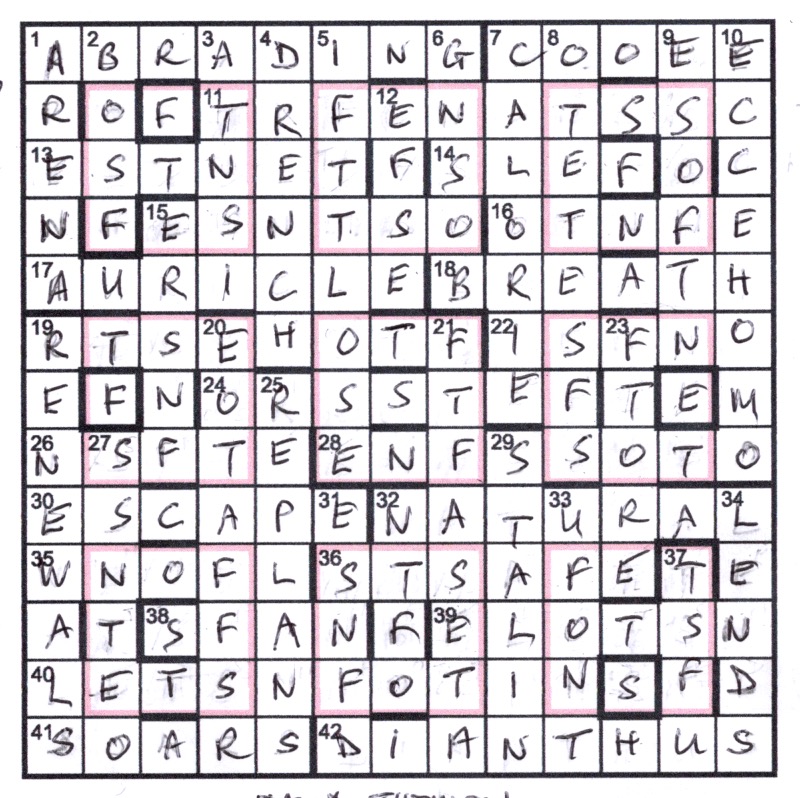
Well, we got there in our novice way, with only one real slip along the way when we tried to establish the top third on its own – but needed a stiff drink afterwards. For wordaholics like us the pay-off at the end was less rewarding than how we presume it must have been for those more numerically inclined whose pulse was set racing by the elegant numerical construction or for those like Smidgers whose pulses are set racing by suddenly seeing how to solve a near impossibility.
“Nurses lager (7)” (FOSTERS of course) at least means we can cheerfully welcome Smidgers into the Oenophile Club and hope that he/she/they will be back soon – and perhaps with something more up our street.
I think that most normal people would work on it the same way as you, Chalicea! Sorry this was more Sudokular than the fare you’re used to, but thanks for the writeup. Seems to have gone down generally well! Very fun to set – this was a ‘I wonder if I can’ sort of puzzle.
I’m not convinced that QXW would help with solving in this case, btw…
Not in the slightest bit interested in su doku and when I do the Listener I expect a crossword puzzle – a hard one, yes, but recognisably a crossword. I would but DNF but it’s more accurate to say DNS
I think this arguably is a crossword, in spite of the jumbles (which usually turn a puzzle into a jigsaw not a crossword). The fact that you know which letters are in the answers makes up for the information lost by jumbles. Excellent puzzle I thought