Thanks to IO for a fantastic challenge.
The longer phrases were very helpful in filling the grid. IO is brilliant at original devices and clueing which makes for a most enjoyable solve. Well worth the perseverance – as we know IO can be very tricky!
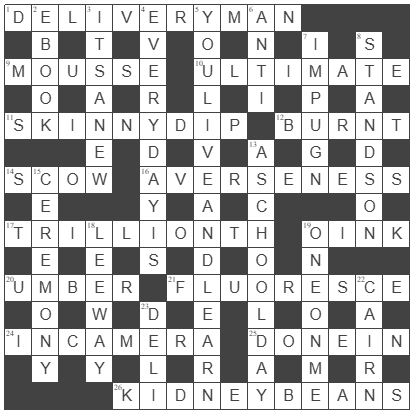
NAMED< (called, <about) collecting LIVERY (uniforms)
MOUSE (Mickey maybe) wants a second S[ummer] (taste of)
(LA[s]T MI[n]UTE)* (*enlivening, S/N (poles) struck)
S/N being South and North
(S[ea] (heading for) + KIP (go off)); (INN (bar) + Y[ear-roun]D (clothes for)) bathing – &lit
BURBER[ry] (fashion house, RY (line) dropped); acquiring N (northern) + TUM (corporation)
RY = railway/line
CO (business, company) in the SW (Falmouth area, South West of England)
AVER (state) + SENS[e]S (understands)
We must move the third E (base, mathematical) closer to the second E, i.e. one letter up so that ‘sensEs’ becomes ‘senEss’
TRILL (sound tremulous) + LIONTH (Athlan and Thimba)
The setter is ‘lisping’ so we must do the same. The LIONS are of course Aslan (C.S Lewis’ Narnia) and Simba (The Lion King)
‘Sharing a cell’ means there is crossover of one letter in the grid. The last L from TRILL is the same L starting LIONTH.
Cryptic definition
O (no/zero) + INK
Catching RE (on); (CLUES OF)* (*flimsy)
For the surface – Flimsy is a regular cryptic setter in the FT as well
Cryptic definition: IN CAME RA
Burlington House houses the Royal Academy of Arts, so if the door opens, RA (an artist) might come in
Definition – as in the Latin phrase
NEIN (Merz’s refusal) to attend DO (function)
Merz is the German chancellor, so in German, ‘no’
SKIN* (*damaged) probed by (A&E + BY (prior to) + END (demise))< (<western)
OBE< (order, <reverse) + OK (to sanction)
OBE = Order of the British Empire, a military award
Cryptic definition – A play on words
This definition serves for the next two down clues as well, indicated by the numbered list
(YALE DISCOVERY)* (*original) + (HAD SOYA)* (*in the mix)
The definition is in 3 down’s clue.
YARN (story) will captivate [s]OUL[s] [g]IVE[n] [c]ANDLE[s] (naked)
The definition is in 3 down’s clue
[me]ANT I[t] (only some)
UP-[and]-[co]MING* (*swinging, bar CAN DO)
(SO MANY CONTENDERS)* (*to sort out)
“WE LAY” (compilers bet) – Spoonerism
In CAN (may); IR (taxmen, Inland Revenue)
DEL[h]I (Indian city, H (hotel) is wanting)
I finally completed an Io without any aids but I did fail to parse SKINNY-DIP. I originally entered ‘It’s a new one to me’ but saw DONE IN had to be right so then got the answer correct. I felt that ‘fluoresce’ equates to ‘glow’ rather than ‘glowing’ (or ‘are glowing’) but happy to be corrected.
Those lights are glowing/fluoresce works ok.
Agree, Oriel, Enigio can be mean, but this one was pretty cruisy.
The ‘I didn’t know that’ trio was my top fave.
Other faves: AVERSENESS and TRILLIONTH.
Great puzzle and superb blog.
Thanks Io and Oriel.
Thanks gratinfreo. So the ‘are’ should be underlined.
Re 22d (CAIRN): in the UK IR [Inland Revenue] became HMRC in 2005, and it certainly wasn’t staffed entirely by men.
I have a personal preference for clues that don’t use link-words to connect definition and wordplay, so all of these pass that test (in FLUORESCE I read ‘are’ as part of the definition).
Does Orwell have any role in the wordplay for 19a (OINK)?
Yep H&H @4&5, the ‘are’ is def def.&
Thanks Io and Oriel. Completed in one session of just under double my notional par time for a daily crossword. I agree with others on the definition for FLUORESCE in 21ac. As no one else seems to have mentioned it yet, I will just give my view that it is not Io’s fault that the two-em rule (horizontal line) which presumably should be at the end of the clue in 24ac was misplaced (on the pdf at any rate) and appeared to be striking out the letters “ed Me” in the clue for 25ac.
The first time for a long time (if ever) that I have completed an Io, though four answers were guesses. I often don’t even attempt his puzzles. This one I actually enjoyed. Thank you.
I wish people wouldn’t use LEEWAY to mean wiggle room (a good thing) rather than something you lose in navigation (a bad thing). The modern usage is in all the dictionaries now so the battle has been lost, but as recently as 1987 the OED gave only the negative meaning.
Thanks for the blog , far from easy but on the friendly end of the spectrum for IO , the long entries helped a lot and there seemed to be a lot of anagrams .
SKINNY-DIP could have been written for me but I do not actually like the term , it is just called swimming .
24/25Ac has the same glitch in the paper but just affecting d M . Did not seem to cause any bother .
18dn: SOED 2007 p 1574 dates the figurative use of leeway as late 19th century, with the definition “Freedom of action within set limits; room allowed for this; a safety margin.”
Roz@9: Actually, on a closer look, the apparent strikeout in 25ac only covers “d M” – the rest was the lines across the middle of the letter “e” each time. It slowed me down, but not for very long.
Another tricky one – no surprise there – and there were a few lucky guesses (as per usual). The strange ruling out of d and M in 25 meant this was my last one in as it threw me off course for a while.
Anyway, it was well worth persevering. The three connected answers were very good but my favourite was OINK.
Thanks Io and Oriel.
I’m delighted to have finished an Io, even though I needed to come here for the parsing of three of the answers. I loved the “I didn’t know that” set of clues and OINK. So thank you Io and Oriel for making my day!
#8 #13 I dream of the day I can finish an IO.
Online, 24 ends with four underscores and a question mark.
Great crossword – thanks to all.
Can someone check that everything is alright with IO? Not only did I finish this (which I do do occasionally) but I also managed to fully parse it which is even rarer if not the first time! Helped a lot by the interlinked long clues giving me a lot of letters.
Liked OINK and SKINNY-DIP
Thanks Oriel and IO
I occasionally finish an Io, with a little help, but I don’t think I have ever enjoyed one as much as this. OINK made me smile, IN CAMERA provided a nice delayed penny drop moment. TRILLIONTH was a fine clue, too.
Really enjoyed this little excursion away from normal crosswords. Neo has always been on my “tread warily” list, and is now becoming one of my favourites. I needed a fair bit of help with anagrams on this one, and among the ticked clues my faves were 1A, 10A, and 5D. In 17A the phrase “sharing a cell” was 3/19 to me, but then again I suppose … 4/13 so 5D.
It seems that 11ac has two errors. First, ‘bathing‘ is a containment indicator. Second, any insertion indicator replacing it needs to be in the present tense, eg ‘enters‘, ‘cuts‘, ‘breaks‘, because the correct cryptic parsing should be: (Heading for sea + go off) [that] (bar + clothes for year-round) enters, i.e. (S + KIP) [that] (INN YD) enters. Shame, as this kills the &Lit.
11ac: I can see that bathe as a transitive verb works as a containment indicator. As an intransitive verb (as here), Chambers 2016 p 129 gives us “to take a dip or swim”, which is good enough for me as an insertion indicator, no matter what it says on any third party web site. The participle is also reasonable: it does not have to be “KIP that INNYD enters”, it can be “KIP, INNYD entering”.
People bring crosswords to me at work sometimes , just for a bit of help , often the Metro but others as well including the Listener . When I help Listener solvers they always start going on about cryptic rules and grammar , as soon as they mention the Clue Clinic I just scream . I usually have students around and one of them will whisper – someone mentioned the Clue Clinic .
11ac revisited: I think I could have got the logic clearer. Start with the participle, so the construction is “S + KIP, INNYD entering”. Then we need an intransitive verb to replace “entering”, so, using the definition cited in comment 20 we can have “S + KIP, INNYD taking a dip” and hence “S + KIP, INNYD bathing”.
I agree with those who actually enjoyed this offering from Io. I liked the linked clues as well as TRILLIONTH and OINK. I didn’t bother finishing the parsing on penultimate entry IMPUGN but I’d have got there if necessary.
Thanks Io and Oriel.
11ac re-revisited. Long-distant memories of Azed slips suggest that the indication of Y in X under Ximenean rules requires either X Y enters or X Y’s entering, but not X Y entering. This follows as the first two forms are grammatically sound ellipses of X that Y enters and X that Y’s entering, both of which flag the insertion of Y into X. However, there is no corresponding ellipsis of the grammatically meaningless third form X that Y entering.
Put another way, the first two forms cycle the standard subject + pres-ind-verb + object structure into the rarer-but-legitimate object + subject + pres-ind verb. Given this, the terminal verb has to be transitive — Y cuts X ✅, Y enters X ✅, Y bathes X ❎ — which confirms on a second front that ‘bathing’ shouldn’t have been used.
Blimey!
Martin@25 , I get this at work sometimes when I help people with the Listener , there is only one possible response , see me @21 .
11ac works perfectly well if you note the assumed comma in “X, Y entering”, or, if you prefer, an assumed pair of brackets as “X (Y entering)”. If you like, you can think of either of these as an ellipsis of (something like) “X with Y entering”. This would appear to be acceptable to the FT editor, who has the only authority for the FT series of puzzles.
Roz@26 are you saying that you find irritating/vexing those (in my experience, extremely erudite and analytic) who put gargantuan effort into studying the Craft of the Crossword, and who make beautifully researched resources from which countless setters/solvers benefit greatly?
There’s nothing personal, churlish or contentious in discussing such finer points of cluemanship, not least as they are interesting and we all learn from such technical debate. Sure, the Clue Clinic makes errors, as do we all, but it is open in publishing its organic position on such matters in a transparent and helpful way.
PB@27. Sorry, but nested brackets don’t save the day here, as proven earlier. The clue at 11ac is acceptable only from a Libertarian viewpoint as, grammatically, it doesn’t say what it means.
@George Funnyname, you haven’t proved anything, and don’t help your arguments by making such a silly claim. For one thing, showing that a thing may be done one way is not sufficient to show that it may not be done another. And then, you explicitly show that you have misunderstood Pelham Barton’s point when you say ‘there is no corresponding ellipsis of the grammatically meaningless third form, X that Y entering’. Nobody is suggesting ‘X Y entering’ expands to ‘X that Y entering’, which would be nonsense as you say. However, it may expand to ‘X with Y entering’, which is a perfectly natural construction, equivalent to Latin’s ablative absolute.
For examples:
The motion was passed, none dissenting
Weather permitting, we’ll have a picnic
The video was paused, dad coming in with some popcorn
The problem with the clue in question is that the punctuation does not match the required structure, i.e. the comma in the surface isn’t where you’d want it for the cryptic. Some may regard that as a problem, most I think don’t care, regrettably IMO.
Where a transitive verb is definitely required is when the containment indicator is present indicative.
(so, ‘X Y enters’ is OK, but ‘X Y makes an entrance’ is not)
S + kip [with] innyd bathing [in it]. Zilch problemo.
Great even by JH’s standards.I loved O INK
In fact, 23d DELI’s clue is an example of the problem complained about, as applied to removing rather than containing. ‘City hotel is wanting’ can’t mean ‘DELHI that H has gone from’ unless you read it as two entirely separate sentences.
J@33 agreed: “City wanting hotel” required. Also, though we go round the block via different routes and say it in different way, we both effectively agree that 11ac doesn’t say what it means. In the cold light of day, GIF@30‘s comment crystallises the problematic issue.
As discussed above, the present-indicative O/S/V form “X [that] Y enters” works because it is grammatically equivalent to the cycled S/V/O form “Y enters X”, and in both forms ‘enters’ is a transitive verb.
However, this cycling cannot be implied in the present-participle form “X [with, comma, having] Y entering” in which the terminal verb is by default taken as intransitive (see SB@22). In this case, whether or not the clue spells it out, the clue must take into account that eg “X with Y entering” is shorthand for “X with Y coming or going into a place”; irrespective of the surface reading, the action of the verb has already been spent (on ‘a place’) in the cryptic reading, so it can’t then be applied again (on X). This is what makes GIF’s suggestion S + kip [with] innyd bathing [in it] impossible: spelt out fully, it has to be S + kip [with] innyd bathing [in water].
In brief, it’s OK for a surface reading to misdirect a cryptic reading, but it’s anything but Ximenean for a verb to undergo an implied change from intransitive to transitive in the latter. And I’d venture so suggest that this is why, I am now reliably informed, that (at least) Times setting rules have long-since forbidden the eg “X Y entering” format.
Well, I finished it… I feel that IO goes a further step than most setters, by expecting us to enter his world, where lisping a clue leads to a solution. Also linked clues 3d, 4d, 5d don’t emerge so clearly perhaps on the app… well, that’s my excuse anyway… I’m not sure I’m going to go down the rabbit hole of the semantics, apparently presented by SKINNY-DIP… I seem to remember reading, that in cryptics, one has to ignore punctuation, except perhaps a question mark? Which, if true, makes a mockery of language in general…
I also loved OINK…
Thanks IO and Oriel
George@33
Your paragraph 3: I don’t agree with your conclusion, that the action of the intransitive verb cannot apply to what has gone before. The appended clause with the participle can be unconnected to the main clause, but it does not have to be, eg ‘the bath overflowed, Tom getting in’. However, I see that there is a difficulty with this, that while the ‘getting in’ applies to the bath, the bath is not the cryptic result of the main clause, which is what we need.
Using the bath example, the structure of the skinny-dip clue is just ‘bath, Tom getting in’, because the S + KIP part is just given as two objects that can be treated as a single noun, cryptically. Does the fact that a bare noun can’t really function as a main clause spoil my argument? Perhaps it does.
But if instead of a bare noun, bath was given by a clause, then the ‘Tom entering’ part could certainly apply to it.
Eg
Club and hotel merge, Tom entering
In that case, club (BAT) and hotel (H) make a cryptic BATH, which Tom can enter. So I am defending the ‘X, Y entering’ structure in principle, though whether it works if X is just given as a noun, as here, I can’t quite see through.
J@35. Isn’t it always the case in a cryptic reading that any verbal components are simply processing nounal strings? Also, in your example ‘the bath overflowed, Tom getting in‘, ‘getting in’ (=inserting, slipping in) is surely a v.t. whereas in 11ac ‘bathing [in eg water]’ is a v.i. That is, it’s not the participle nature that’s under discussion but rather the in/transitivity. So the BATH/TOM example works because the initial postpositive verb remains transitive when implied as prepositive, whereas in 11ac the postpositive intransitive ‘bathing’ becomes a transitive containment indicator when prepositive.
It’s this change of function from postpositive intransitive to prepositive transitive — always acting on nounal strings — that to my mind departs from fair game, and presumably this view was at some stage taken by the Times. But I’m happy to agree to disagree.
No, ‘getting in’ is intransitive in that case. It is not necessary for the bath to be the direct object of the verb. Enter, get in, etc. as intransitive verbs have implied objects (as you note above), which are generally clear from the context. In the bath example, the context is explicit – the getting in is done in relation to the bath. But in a cryptic clue where the context is disguised by the surface, we can still infer that the verb acts in relation to what has gone before.
It seems to me you are trying to fit the clue to an inappropriate model, and blaming the clue when you can’t do it.
No blaming going on here, just offering an explanation — by simply expanding (implicitly) the intransitive verb to its full definition — why “X Y entering” is not a globally accepted device given that we seem to agree that, in the cryptic sense, X and Y are simply noun(al string)s.
Indeed, your last point @35 casts doubt that you yourself are convinced the device works when X is a noun so, if there’s been a change of tack, I’d be more than happy to accept a simple explanation (sans alternative examples) of how you think the clue as presented — (S, KIP) (INNYD) bathing — works within the framework of this discussion.
Poor Oriel , a good scream works wonders .