Third time out for Sauce.
Preamble:
The puzzle encapsulates a noted achievement, to be highlighted, by someone named in two unclued entries. Clues within each group are given in alphabetical order of the answers, which are all of different lengths, each entry beginning or ending in the rectangle indicated. After completing the grid, solvers must modify a 7-letter entry as would be directed by the initial letters of all the clues, were they listed in normal across/down order. (Any other entries affected remain real words.)
At first sight this looked rather daunting, but after a short while when I got a bit more in the swing of things it looked less so. And a little later when it felt like I was motoring across the lower half I was really enjoying myself. 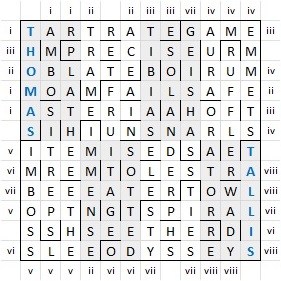 The one or two clues I’d solved in Group I were no help as their answers had ambiguous placings, but TRAM in Group II went straight in as the 4-letter entry started and finished in the same rectangle. Same for TIBIAS in Group III and I managed to both solve & place a lot in Group IV. Things were looking up.
I don’t recall have too much trouble with any of the clues and the grid was filling up quite nicely. It became clear that the unclued entries started/finished in the TL/BR corners, and THOMAS was easy to deduce; TALLIS took just a little longer.
{In the first grid, the Roman numerals around the periphery indicate which group the adjacent entries come from.}
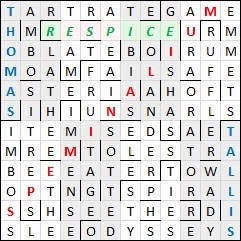 SPEM IN ALIUM, Thomas Tallis’ most famous piece, fell into my lap without delay. Spem in alium (Latin for “Hope in any other”) is a 40-part motet for eight choirs of five voices each – hence here we have 8 groups each with 5 entries. At this point I put the puzzle away, not wanting for it to be over too quickly. I picked it up a few days later to tackle the somewhat tedious task of sorting the clues into the right order to extract the directive. So, select one of the 7-letter entries then JUMBLE TO GIVE A LATIN WORD UNITING ALL THE PARTS.
I dabbled here & there at first, got nowhere, then began a more structured approach (also somewhat tedious): take a 7-letter entry, find Latin anagrams of it, see if intersecting entries were still words. Fortunately, I struck gold with PRECISE in row 2 giving RESPICE translated as consider (see the title – not sure about this though). This starts the last line of the work “respice humilitatem nostram”, at which point all 40 voices join together … all the parts united.
Sauce – great puzzle, lots of fun, thanks.
| Clue | Answer | Wordplay | |
| Group I | |||
| • | Reading-desk, by the way, erected under cover of atrium | AMBO | OB< (obiter, by the way) after A(triu)M |
| • | Oaf dreadfully irate on losing singular starlike gemstone | ASTERIA | ASS (oaf) [IRATE]* ¬ S(ingular) |
| • | Asian club in part of Kent once welcoming Earl | LATHEE | LATHE (part of Kent once) around E(arl) |
| • | Endlessly lament deceased Enzedder | MOA | MOA(n) (lament) |
| • | Jack enthused initially over Italian winemaker’s by-product | TARTRATE | TAR (Jack) E(nthused) around TRAT (Italian restaurant) |
| Group II | |||
| • | Unit of speed, not power | ACE | PACE (speed) ¬ P(ower) |
| • | Trouble certain after onset of fault, without such mechanisms? | FAIL-SAFE | AIL (trouble) SAFE (certain) after F(ault) |
| • | Huge one’s set off in Edinburgh | IMMENSE | I’M (one’s) MENSE (set off, Scot) |
| • | Book recently written by ordinary person dedicated to God | OBLATE | B(ook) LATE (recently) after O(rdinary) |
| • | Device for adjusting machinery making silk yarn | TRAM | double definition |
| Group III | |||
| • | Up for it? Excitement’s beginning after school | GAME | E(xcitement) after GAM (school) |
| • | German court hard on secret society member | HOF | H(ard) OF (Oddfellow, secret society member) |
| • | Make summary of event essentially accurate | PRECISE | PRECIS (make summary of) (ev)E(nt) |
| • | Note penned by eccentric Sea Lord in archivists’ box | SOLANDER | N(ote) in [SEA LORD]* |
| • | Nearly recited piece about ancient flutes | TIBIAS | SAI(d) (recited) BIT (piece) |
| Group IV | |||
| • | Toads and frogs with no name or distinctive character | AURA | ANURA (toads and frogs) ¬ N(ame) |
| • | In Tintagel, tourists almost stopped on way north | EMMETS | STEMME(d)< (stopped) |
| • | Governor maybe entertains very loud old swaggerer | RUFFLER | RULLER (governor maybe) around FF (very loud) |
| • | Liquor from Birmingham getting bishop wasted | RUM | BRUM (Birmingham) ¬ B(ishop) |
| • | Ill-natured looks following Parisian one frees from entanglement | UNSNARLS | SNARLS (ill-natured looks) after UN (one, Fr) |
| Group V | |||
| • | Airy, not substantial, easily expressed by poet | ETHE | ETHEREAL (airy) ¬ REAL (substantial) |
| • | Egotistic manager’s words perhaps no longer drive to extremity | IMBOSS | I’M BOSS (egotistic manager’s words perhaps) |
| • | Vintner mails me regularly with introduction to discounts given in catalogue? | ITEMISED | (v)I(n)T(n)E(r) M(a)I(l)S (m)E D(iscounts) |
| • | Time after work to make choice | OPT | T(ime) after OP (work) |
| • | Latest position’s described by these priests, following reform | SITREPS | [PRIESTS]* |
| Group VI | |||
| • | Little fly consuming first of unseasonably mature produce now stale | FRUITAGE | FRIT (little fly) around U(nseasonably) AGE (mature) |
| • | Exposed crew to medium dose of radiation previously | REM | (c)RE(w) M(edium) |
| • | Newbie ultimately in fix with this woman – she’s getting agitated | SEETHER | (newbi)E SET (fix) HER (this woman) |
| • | Wily Scottish Liberal obstructs judge | SLEE | L(iberal) in SEE (judge) |
| • | Priest disappearing in Lent, American, was habitual drunkard | SOTTED | SPOTTED (lent, American) ¬ P(riest) |
| Group VII | |||
| • | Lacking female, ox-bird becomes displayer of bright plumage | BEE-EATER | BEEFEATER (ox-bird) ¬ F(emale) |
| • | I say, getting upset, Quiet, while these girls entertain! | GEISHAS | I EG (say) both< SH (quiet) AS (while) |
| • | Irish beset by failure, largely reversing gradual rise | SPIRAL | IR(ish) in LAPS(e)< (failure) |
| • | Site of gross debauchery located in East Yorkshire | STY | (Ea)ST Y(orkshire) |
| • | Restrains by withholding money | TIES | TIMES (by) ¬ M(money) |
| Group VIII | |||
| • | Old yachters share yarns, all empty tales of wandering | ODYSSEYS | O(l)D Y(achter)S share yarns |
| • | Additive replacing fat, derived from a sterol | OLESTRA | [A STEROL]* |
| • | Top Fijian King has promoted over eloquent person | ORATOR | RATOO (top Fijian) R (King) with O(ver) earlier |
| • | Avian predator’s cry of distress when quarry finally escapes | OWL | YOWL (cry of distress) ¬ (quarr)Y |
| • | Track crossing deserted river valley | WADY | WAY (track) around D(eserted) |
I fear I spent some time on the architect Thomas Wallis, wondering how on earth his masterpiece “the India Rubber Company factory at Inchinnan in Renfrewshire” (says Wikipedia) could be concealed in the grid. But finding SPEM IN ALIUM on a diagonal put me right, and despite some haziness about how motets work it wasn’t hard to spot the anagram of PRECISE in the last line of a short text. Many thanks to Sauce for stretching my mind in an unusual direction and to HG for making it all clear.
I found this Sauce rather difficult to swallow! All the clues were sound but made more difficult by a number of (to me) obscure words, not only as entries but also as indicated in the word-play. As a Kentish Man, I was totally unaware of this old meaning of lathe in 13D – turner would have been kinder. I spotted THOMAS TALLIS which helped to reduce the options for locating some of the solved answers. In the end, I was grudgingly pleased to have completed the grid
The final stroke, however, defeated me. I am sure HG is correct but his route to finding it was tortuous to say the least. I gave up after a fruitless search for this obscure reference, despite having passed O-level Latin decades ago.
Thanks to Sauce for a clever grid, which must have taken longer to design than it took me to fill it. And thanks to HG for a marathon analysis.
Thanks also to DL @1 for the big hint on the diagonal, which I overlooked, as, it seems, did HG.
@2 HG’s second grid shows that diagonal in red letters!
Comment #4
DL @3. Of course! I did not spot that. Apologies to HG.
Wow, I don’t think I’ve ever taken so long to find my first answer. It was OPT which at least helped me to start tentatively filling V group. From there, slowly things unfolded. I love being in that stage of using crossers and guesses to help identify which answer might go where – even when you’re not sure what the answer is or which clue to use in the first place! The crossword had the right level of difficulty for me to occupy a couple of evenings.
Mind you, I completely missed the diagonal having forgotten we were supposed to highlight the work.
A great puzzle. Thanks Sauce and to HolyGhost for your excellent blog.
Agree with above: excellent challenge. I found the three letter answers significantly easier than the rest, which was good for morale as I could safely enter most of them. As for the latin anagram, my route was a little less tortuous than HG’s: listing the eight answers, and then reading the Wiki page on Spem in Alium: ‘respice’ popped up quite conspicuously. Like Fisher@6, I forgot to look for / highlight the work. Thanks to Sauce and HolyGhost – especially for pointing out the eight-by-five mirroring.
Holy Ghost has highlighted in the blog that the eight blocks of five clues represent the eight choirs of five voices that sing Spem In Alium. I thought there was maybe an additional thematic point in that the answer lengths to the five clues in each block were 3, 4, 6, 7 and 8.
I understand that each of the eight choirs have one of each of the same five voices – alto, bass, tenor, soprano and baritone – so I am left with the thought that each set of five answers represents the same five voices. Unfortunately, these voices are 4, 4, 5, 7 and 8 letters long, with two the same length, so it would have been difficult to distinguish them uniquely by answer lengths.
I enjoyed this crossword which took me a while to understand before Thomas Tallis appeared.